People looking up SD window tint are usually trying to book a car, not collect shop slogans. In the City of San Diego that choice starts with your route and your parking, then with California’s window rules, then with a written film quote that names each glass position.
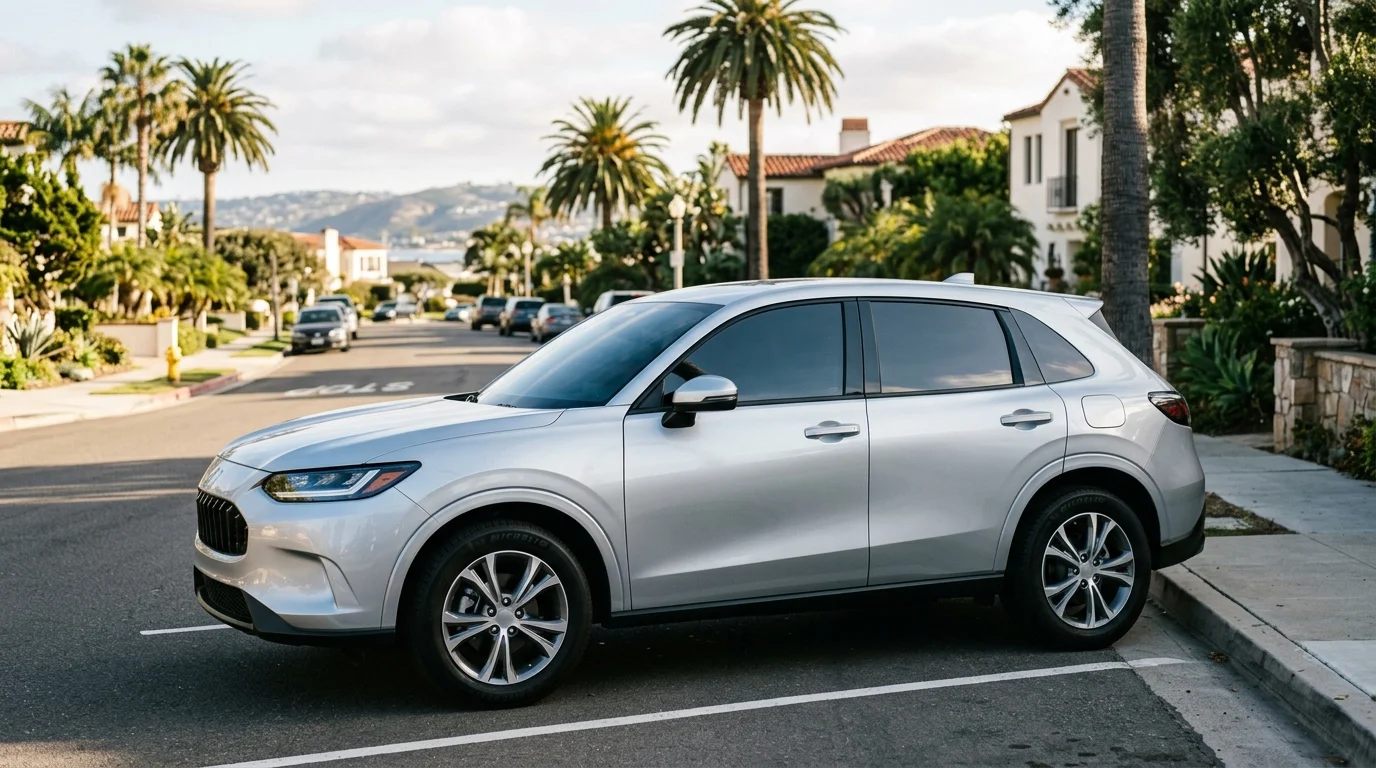
Start with where you drive and how the car is parked
A Clairemont driveway and a Little Italy garage do not cook a cabin the same way. The City of San Diego stretches from the water to inland lots, and the film that feels right in one place can feel wrong in another.
If the car lives near the water in Pacific Beach, Mission Beach, Ocean Beach, La Jolla, or Point Loma, glare often leads the brief. Late sun on westbound streets, bounce off the Pacific, and bright concrete around Lindbergh Field all hit the driver’s eyes. Morning marine layer can make a dark rear look mild at 8 a.m. The same glass can feel heavy on I-5 south toward downtown at 4 p.m.
If the car sits all day in Mission Valley, Kearny Mesa, Mira Mesa, Linda Vista, or Serra Mesa, heat leads instead. Those lots get less of the coastal filter. Dashboards, steering wheels, and child seats take more sun. If you also want paint help in that same inland heat, start with ceramic coating in the City of San Diego and keep film on glass as its own job.
Commutes split the brief again. I-5 through downtown and past the airport is stop-and-go time in open sun. I-8 through Mission Valley and Grantville bakes the driver’s side on the afternoon return. I-15 through Mira Mesa and Kearny Mesa is a long, bright run with little tree cover. None of those routes needs the same shade on every window.
Street parking changes the privacy question. North Park, Hillcrest, University Heights, City Heights, Golden Hill, and East Village put more people walking past the cabin. Rear glass may be the reason you book. A covered stall in a downtown tower or a garage in Bankers Hill cuts that pressure. Do not copy a neighbor’s shade until you know how they park.
Front sides, rear sides, and the back glass do different jobs. California treats them as different glass. The independent installer you book should ask where the car lives, which seats get used, and which windows you actually roll. That conversation is the start of window tinting, not a color chip on a counter.
How darkness, glare, and heat rejection differ
Darkness is visible light transmission, usually written as a percent. A lower number lets through less visible light, so 20 percent film is darker than 35 percent film. That is the whole comparison when someone asks which of those two looks darker. It does not tell you which shade belongs on a front door.
Glare is the bounce off water, glass towers, and pale concrete. Heat is the load that makes the cabin uncomfortable after an hour in a Mission Valley lot. Those loads travel together, and they are not the same. A darker dyed film can look private and still do less with heat than a lighter ceramic film in the same parking stall. Compare the written specification at the quoted shade. The label on the box is not the spec.
Ceramic tint products can use ceramic particles to manage heat and UV. Dyed tint uses dye for appearance and privacy. Color-stable dyed products exist, so do not assume every dyed film will turn purple or bubble. Carbon-based, nonmetal films exist too. None of those constructions is a universal winner. Ask for the spec sheet for the exact shade on the quote. Our ceramic, dyed, and carbon film comparison walks through that difference in more detail.
Metalized films can interfere with signals. Ceramic constructions are the usual way shops avoid GPS, phone, and toll-pass trouble on I-5 and I-15. Keep the benefit talk qualitative. Professional-grade film cuts UV exposure and can reduce interior heat and glare. Do not trust a round percentage on a sales card unless it is on the sheet for that product.
Factory privacy glass on many SUVs already looks dark in the rear. Adding film on top changes the cabin more than the same film on clear glass. Have the pro hold samples on your actual windows in daylight, not only under shop lamps. A sample on a Mira Mesa lot at noon is more honest than a card in a dim bay.
If you are also coating paint, film on glass and a coating on paint are separate jobs. Window tint and ceramic coating can go on the same car, and the installer should sequence them so wet film work does not land on fresh coating.
What California rules require you to verify
California Vehicle Code section 26708 is the statewide tint statute. Read the current text on the California legislative site. The City of San Diego does not replace that code. If you need an enforcement question answered, ask the California Highway Patrol and read the statute. A separate city tint ordinance was not confirmed here.
Do not treat a shop slogan as a legal verdict. The code is position-specific. This page will not declare a given film legal on a given window.
Front side windows
The front-side exception in CVC 26708(d) is for clear, colorless, and transparent material. The film itself must have a minimum visible light transmittance of 88 percent. The glazing with film applied must meet FMVSS 205’s 70 percent minimum light transmittance.
That is why a 20 percent film is the wrong starting point for front doors. It sits far below the 88 percent film minimum in that exception. If you want to know what the 70 percent installed look is, read what 70 percent window tint looks like.
The same exception requires you to have, in your possession or in the vehicle, a certificate from the installing company. If you installed the material yourself, the certificate comes from the material manufacturer. The statute requires that certificate. Do not leave a front-side job without it.
Glass behind the driver, and the rear window
Side windows to the rear of the driver are exempt from the obstruction prohibition in CVC 26708(b)(4). That exemption is not a blank check for any color, and it is not a published “darkest legal in SD” number.
The rear window may be tinted only if the vehicle has outside mirrors on both the left and right sides, positioned to give the driver a view at least 200 feet to the rear (CVC 26708(b)(8)). Check the mirrors before you book the back glass.
Windshield
Transparent material is allowed only on the topmost portion of the windshield. The bottom edge of that material must sit at least 29 inches above the undepressed driver’s seat. The statute does not describe a “top four inches” strip. That material is not red or amber in color. Do not turn the red and amber windshield-strip limit into a vehicle-wide color ban.
A longer walkthrough of the same statute is in our California window tint law guide for San Diego. A stop for illegal window obstruction is a Vehicle Code issue statewide, including inside the City of San Diego. This page does not invent a ticket amount, a warning policy, or a CHP quota. Confirm the current section text before you argue a shade.
What a written film quote should identify
A useful quote is a window-by-window list, not a single darkness name.
It should name the vehicle year, make, and model. It should list each opening: front sides, rear sides, rear glass, and any sunroof the shop is willing to film. It should state the visible light transmission for each of those positions, in writing.
It should name the film construction you are buying at that shade, whether ceramic, dyed, carbon, or another professional-grade tier the installer recommends. Stay brand-agnostic. You want the product tier and the spec sheet, not a sticker.
It should say whether existing film comes off first, and whether that removal is in the quoted price. Old film on a City Heights daily driver is a different job than a new car from a Mission Valley dealer with clear factory glass.
It should state the written film warranty the installer will put on paper. Your installer confirms that warranty in writing. This site does not publish a year count.
In San Diego, window tint is typically quoted around $300-$700, with sedans often in the $300-$500 range and SUVs often in the $400-$700 range, depending on size and how many openings are filmed. Your installer confirms the written price. Getting matched through Paint Shield SD costs you nothing.
Ask how long the car stays with the pro. Typical on-site time is often in the 1-3 hour range, and that is an expectation the pro confirms, not a scheduling promise. Same-week scheduling available for most services.
The quote should also cover the certificate for front-side film, and the care sheet for window operation after install. Do not guess a universal windows-up rule. Product instructions control that.
Questions to ask an independent tint pro
Independent pros install the film. Paint Shield SD refers you to vetted, insured local installers. You contract and pay the pro directly.
Ask where they want to see the car. A sample on your glass in a Kearny Mesa lot at noon beats a card in a dim bay.
Ask which visible light transmission they would put on each position for your commute, and why. A Point Loma westbound drive and an I-15 Mira Mesa run are not the same brief.
Ask for the spec sheet at the quoted shade. Compare heat and UV language on that sheet. Keep performance talk qualitative unless the sheet is in your hand.
Ask whether the film is metalized. If you rely on GPS, a phone, or a toll pass on I-5, that question matters.
Ask how they will match factory privacy glass on an SUV so the rear does not go near-black while the fronts stay near clear.
Ask who issues the CVC 26708 certificate, and whether it stays in the glove box.
Ask what happens if an edge lifts, a dust speck is trapped, or haze remains after the film dries. Get that process in writing.
Ask whether they will refuse a front-side shade that cannot meet the 88 percent film and 70 percent installed-glass rules. A pro who sells you 20 percent for the front doors is not reading the same statute.
Bring photos of the car in the place you actually park. A covered stall in Little Italy and an uncovered Mission Valley lot argue for different rear privacy, even on the same model.
When to call us
Inland North County heat and I-15 glare are a different compare. Use window tint in Escondido for that city.
Book a pro when you want film that matches your City of San Diego commute and the Vehicle Code positions on your car, or when you want tint planned next to coating or paint protection film. Call us at (760) 400-6557 and we’ll connect you with a vetted, insured local pro.