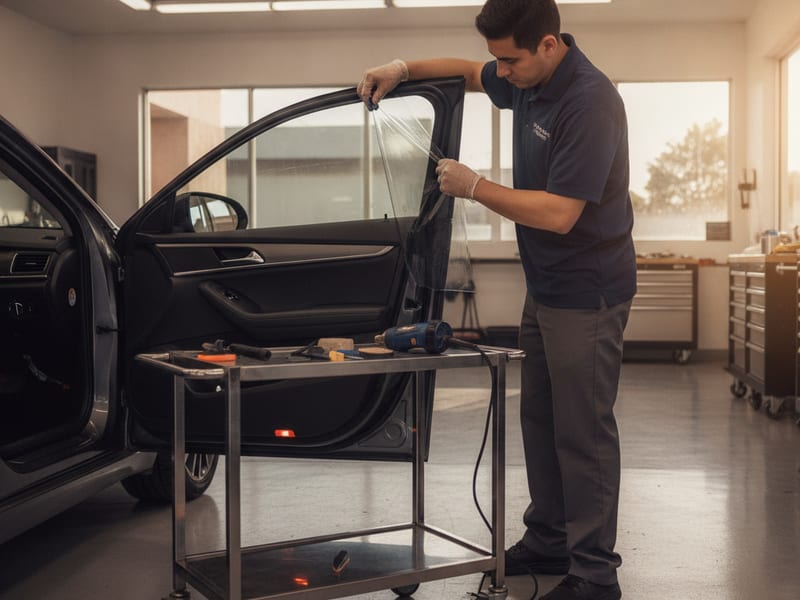
Ceramic window tint, carbon tint, and dyed “regular” tint are not three names for the same film. They use different material approaches. California’s front-window rules still apply to the film and installed glass regardless of construction.
Paint Shield SD matches car owners with vetted, insured local installers. We don’t install the film. Your installer confirms the film tier, the legal VLT for each window, and the written price after looking at the glass.
Dyed film uses dye for appearance and privacy
When people search ceramic tint vs regular tint, regular often means dyed film. Dyed products use dye to create the desired appearance and privacy. That construction alone does not prove how a particular film will age.
If your current film has changed color, cracked, bubbled, or started lifting at the edges, tell the installer when you ask for a quote. The pro should identify the existing material, inspect the glass, and explain the removal and preparation scope before another film goes on.
Dyed film can still be legal if the visible light transmittance meets the rule for that window. Chemistry and legality are separate questions.
Carbon film uses carbon-based construction
Carbon-film products use carbon-based construction, and nonmetal carbon options exist. Exact heat, UV, signal, appearance, and warranty performance varies by product.
Compare carbon with dyed and ceramic products at the same proposed VLT. Ask for the current data sheet and written warranty rather than treating the material name as a universal performance ranking.
Ceramic film uses ceramic particles
Ceramic-film products can use microscopic ceramic particles to manage heat and UV. Ceramic film can avoid the signal interference metalized films can cause, but the label alone does not establish one heat-rejection level or lifespan.
This site doesn’t publish invented heat-rejection percentages. Ask the installer for the current product data sheet for the exact film on the quote. Compare that sheet, the warranty in writing, and the VLT for each window, not a marketing name alone.
The useful choice comes from comparing the actual products at a matching VLT. Review the data sheet, warranty, appearance, and complete written price for each option.
The legal number doesn’t care which chemistry you pick
California Vehicle Code 26708 is about how much light the film lets through, not whether the film is dyed, carbon, or ceramic.
Aftermarket film on the front side windows must itself allow at least 88 percent of light through, and the glass plus film together must still meet the federal 70 percent minimum. Windows behind the driver are exempt from that limit. The rear window can be tinted only if the vehicle has outside mirrors on both sides.
A dark ceramic film on the front doors is still illegal if it fails those tests. A light dyed film can be legal because construction and VLT are separate questions. See 70 percent tint in California for the 88 and 70 tests, and what 70 percent tint looks like for the appearance question.
Ask the installer to match the rated VLT to each window position. This site states the statute, not a verdict on a named film.
Does ceramic tint look different at night?
Darkness is described by the VLT number, not by the word ceramic. Compare actual samples at the same rated VLT, because construction labels do not replace a visibility check.
A darker rear-window film will cut more nighttime visibility through that glass, whether it is ceramic or dyed. Front side windows in California have to stay at the 88/70 tests, so those windows stay relatively light. If night driving is the worry, ask to see the proposed VLT on the car after dark, or at least on a sample against a lit parking lot, before you approve it.
Don’t pick from the construction name alone when night visibility is the concern. Confirm the proposed VLT and inspect a representative sample in useful lighting before approving it.
What a San Diego quote should list
A useful quote names the film chemistry, the VLT for each window position, whether old film is coming off, and the written warranty. A standard four-door sedan typically runs $300-$500. SUVs and trucks with more glass typically run $400-$700. Front-two-window jobs cost less than a full vehicle. Old film removal adds time and cost. Your installer confirms the written price after seeing the glass.
If two quotes use the word ceramic and different prices, ask for the data sheet and the warranty terms. The word is not a specification.
Call (760) 400-6557 and we’ll match you with a vetted, insured local installer. Getting matched is free.