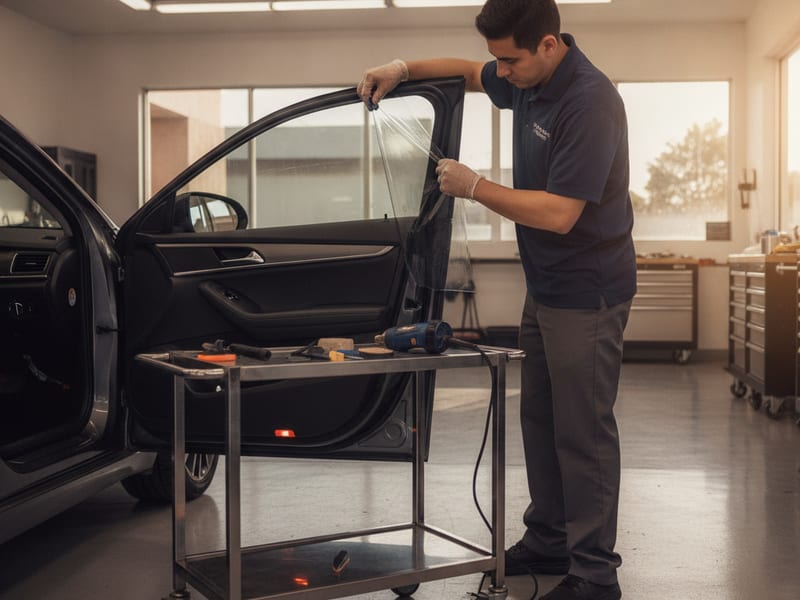
70 percent tint is not a single legal shade in California. Front side windows still have to meet 70 percent as glass plus film. The film itself has to be an 88 percent product under California Vehicle Code 26708. The windshield is a separate rule: transparent material only where the bottom edge is at least 29 inches above the undepressed driver’s seat, not a four-inch strip.
What does California window tint law actually say?
Two things, and most guides state both of them loosely. On the front side windows, California Vehicle Code 26708 requires that the film itself have “a minimum visible light transmittance of 88 percent,” and separately that the glass with the film applied still meet the federal standard’s “specified minimum light transmittance of 70 percent.” Those are two different tests, and the 88 percent one is the part people miss.
On the windshield, the statute allows transparent material only where “the bottom edge of the material is at least 29 inches above the undepressed driver’s seat.” That is the actual rule. It is not a four-inch strip, and if you have read otherwise you have read one of the many pages that repeat it.
The rest of this page walks each window position, because the rules are position-specific and the enforcement consequence is real.
California window tint percentages by position
People search a percentages chart because they want one number. California does not publish one number. CVC 26708 is a table of positions.
| Window | What the current statute actually requires |
|---|---|
| Front side windows | Clear, colorless, and transparent film. The film itself has a minimum 88 percent VLT. The glass plus film still has to meet the federal 70 percent minimum. |
| Windshield | Transparent material only where the bottom edge is at least 29 inches above the undepressed driver’s seat. That material is not red or amber. It is not a four-inch strip. |
| Side windows behind the driver | Exempt from the obstruction prohibition (CVC 26708(b)(4)). |
| Rear window | May be tinted only if outside mirrors on both sides give the driver a view at least 200 feet to the rear. |
That table is the legal map. Appearance of a 70 percent film is a separate question: see what 70 percent window tint looks like. Color names are a third question: see is colored window tint legal in California.
Front side film also has a paperwork rule that chart pages skip. CVC 26708(d)(4) requires a certificate from the installing company (or from the material manufacturer if the owner installed it), in your possession or in the vehicle. Ask for it before the film goes on.
Why the “70 percent” answer is incomplete
Nearly every tint page you will find says front side windows must be 70 percent VLT and stops there. That is half of it.
CVC 26708(d) sets two conditions that both have to hold. The first is about the product: the material has a minimum visible light transmittance of 88 percent. The second is about the result: the glazing with film applied must meet FMVSS 205’s 70 percent minimum light transmittance.
That combination is why a shop will tell you that you cannot put a normal darkening film on your front doors in California. Your factory glass already absorbs some light before anything goes on it. Once you add film, the assembly has to still pass 70 percent, and the film on its own has to be a 88 percent product. In practice that leaves clear or near-clear films on the front doors, which is why they are usually sold for heat and UV rather than for looks.
Ask your installer for the film’s rated VLT, in writing, before it goes on the car. A roadside meter reads the installed glass plus film, which still has to meet 70 percent.
The windshield rule: 29 inches, not four inches
This is the single most repeated error in California tint content, including on pages written by law firms and tint shops.
CVC 26708 permits transparent material on the windshield where the bottom edge of the material is at least 29 inches above the undepressed driver’s seat. The measurement runs from the seat, not from the top of the glass, and it is stated in inches of clearance rather than as a fixed band.
Why that distinction has teeth: a four-inch strip on a lifted truck and a four-inch strip on a low sports car are completely different amounts of obstruction relative to where the driver’s eyes actually sit. The statute is written around the driver’s position, which is the thing the rule is protecting. Measure from the seat, and have the installer show you where the line falls in your car.
Rear and side windows behind the driver
The rules loosen considerably behind the driver, which surprises people who assume one darkness applies to the whole car.
Side windows to the rear of the driver are exempt from the obstruction prohibition under CVC 26708(b)(4). The rear window has its own condition under CVC 26708: it may be tinted only if the vehicle has outside mirrors on both the left and right sides, positioned to give the driver a view at least 200 feet to the rear.
Read that as a trade. You can lose rear visibility through the glass, provided you have kept it through both mirrors. If a mirror is missing, folded away permanently, or damaged, the condition the rear tint depends on is not being met.
What is the darkest legal window tint in California?
There is no single darkest-legal number for the whole car. San Diego search results and shop pages often treat rear darkness as unlimited and treat 70 percent as the front shade. Both of those shortcuts skip tests in CVC 26708.
On the front side windows, the darkest legal result is still a high-transmittance film. The film itself has to be at least 88 percent VLT, and the glass plus film still has to meet 70 percent. A darker product that looks legal on a rear door is not a front-door answer. Ask the installer for the film’s rated VLT in writing, then confirm the installed meter reading after the work.
Behind the driver, the statute does not publish a darkness floor the way it does for the front. Side windows to the rear of the driver are exempt from the obstruction prohibition. The rear window may be tinted only with outside mirrors on both sides that give a 200-foot view. That is not a license to pick any color. Front-side film still has to be clear, colorless, and transparent. The windshield strip still cannot be red or amber. This site does not declare a specific rear film legal.
If the question is what 70 percent looks like on glass, that is a separate appearance question: what 70 percent window tint looks like. Color names are a third question: is colored window tint legal in California.
What about ceramic tint?
Ceramic tint is a film construction, not a legal category, and the law does not care what the film is made of. It cares about light transmittance and position.
What ceramic film changes is performance rather than legality. Ceramic films reject heat without the metal content that older metallized films used, which is why they avoid the signal interference metalized films can cause with phones, GPS and toll transponders. On a front door where the law effectively limits you to a near-clear product, a ceramic film is how you get meaningful heat and UV reduction while still being a high-transmittance film.
That trade matters more inland than on the coast. An El Cajon or Santee car parked outside all afternoon is fighting a very different heat load than one in Del Mar.
What happens if your tint is illegal
Enforcement is roadside and it is measured, not eyeballed. Officers use a meter on the glass.
Treat any specific fine figure you read online with suspicion, including on this page, which is why there is not one here. What is worth planning around is the shape of the outcome: a tint violation is a correction problem first, meaning the film has to come off, and removal plus re-tinting to a legal product is a cost you pay on top of whatever the original install cost.
The practical protection is boring and effective. Get the film’s rated VLT in writing on the invoice before the work starts.
What this means before you book
Three things worth settling with the installer in advance.
Ask which specific film and rated VLT they plan to use on each window position, because the answer should be different for the fronts than for the rear. A shop that quotes one darkness for the whole car has not thought about your front doors.
Ask them to measure and show you the 29-inch line on your windshield rather than describing a strip.
And ask what the film’s warranty covers, in writing. Tint fails visibly when it fails, through purpling, bubbling or delamination at the edges, and the warranty is what decides who pays for the removal.
Frequently asked questions
What is the legal window tint limit in California?
Two conditions apply to the front side windows and both have to hold. CVC 26708(d) requires the film itself to have a minimum visible light transmittance of 88 percent, and requires the glass with the film applied to still meet the federal 70 percent minimum. Most guides quote only the 70 percent figure, which is why so many drivers are surprised at the shop.
Can I tint my windshield in California?
Only in a limited band. CVC 26708 allows transparent material where the bottom edge sits at least 29 inches above the undepressed driver’s seat. The widely repeated “top four inches” version is not what the statute says, and because the measurement runs from the seat, the legal line is not in the same place on a truck as it is on a sedan.
How dark can my back windows be in California?
Considerably darker than the fronts. Side windows to the rear of the driver are exempt from the obstruction prohibition under CVC 26708(b)(4), and the rear window may be tinted only if the vehicle has outside mirrors on both sides positioned to give the driver a view at least 200 feet to the rear. The mirrors are the condition, so they matter.
Is ceramic tint legal in California?
Ceramic describes how the film is built, not a legal category, and the statute regulates light transmittance and position rather than material. Ceramic film still has to meet the same two tests as any other film on the front doors: 88 percent for the material, and 70 percent for the glass with film applied.
Does window tint help with heat in San Diego?
Yes, and it is the main reason to tint a front door here given the transmittance limits. Film cuts UV exposure and reduces interior heat and glare, and ceramic constructions do it without the signal interference metalized films can cause. How much difference you notice depends on where the car parks and how inland it is.
Will I get a ticket for tint that is too dark?
It is measured with a meter at the roadside rather than judged by eye, so a film that is close is still a film that is out. The practical exposure is that illegal film has to come off, and you pay for removal and a legal re-tint on top of the original install.
What tint is legal on the front windows of a car in California?
In practice, a high-transmittance film sold for heat and UV rather than darkness. The 88 percent film requirement and the 70 percent combined requirement together rule out the darker products people usually picture. The front-side exception is also for clear, colorless, and transparent material. Ask for the rated VLT in writing before the film goes on.
Is colored window tint legal in California?
Not as one statewide color rule. Front side film in the CVC 26708(d) exception has to be clear, colorless, and transparent, and still pass the 88 and 70 tests. The windshield strip cannot be red or amber. Rear side glass is exempt from the obstruction prohibition, which is not the same as a color permission list. See colored window tint in California for the position-specific color rules. This page does not declare a named film legal.
For what a professional install includes, see the auto window tint service page, or check coverage in your city, for example window tint in Poway or Pacific Beach. Tint pairs naturally with interior ceramic coating on cars that live outside, since both are fighting the same UV load. To get matched with a vetted, insured installer anywhere in San Diego County, call (760) 400-6557. Getting matched costs you nothing.