A black SUV that looks clean in a Rancho Santa Fe garage can look tired the minute it rolls onto Via de la Valle in midday sun. Wash haze, water spots, and light scratches show on the hood and fenders first. Auto paint correction services in Rancho Santa Fe CA start with that walk-around in real light, then a written scope from an independent pro, not a guess from a dim phone photo.
Start with what the paint shows in direct sun
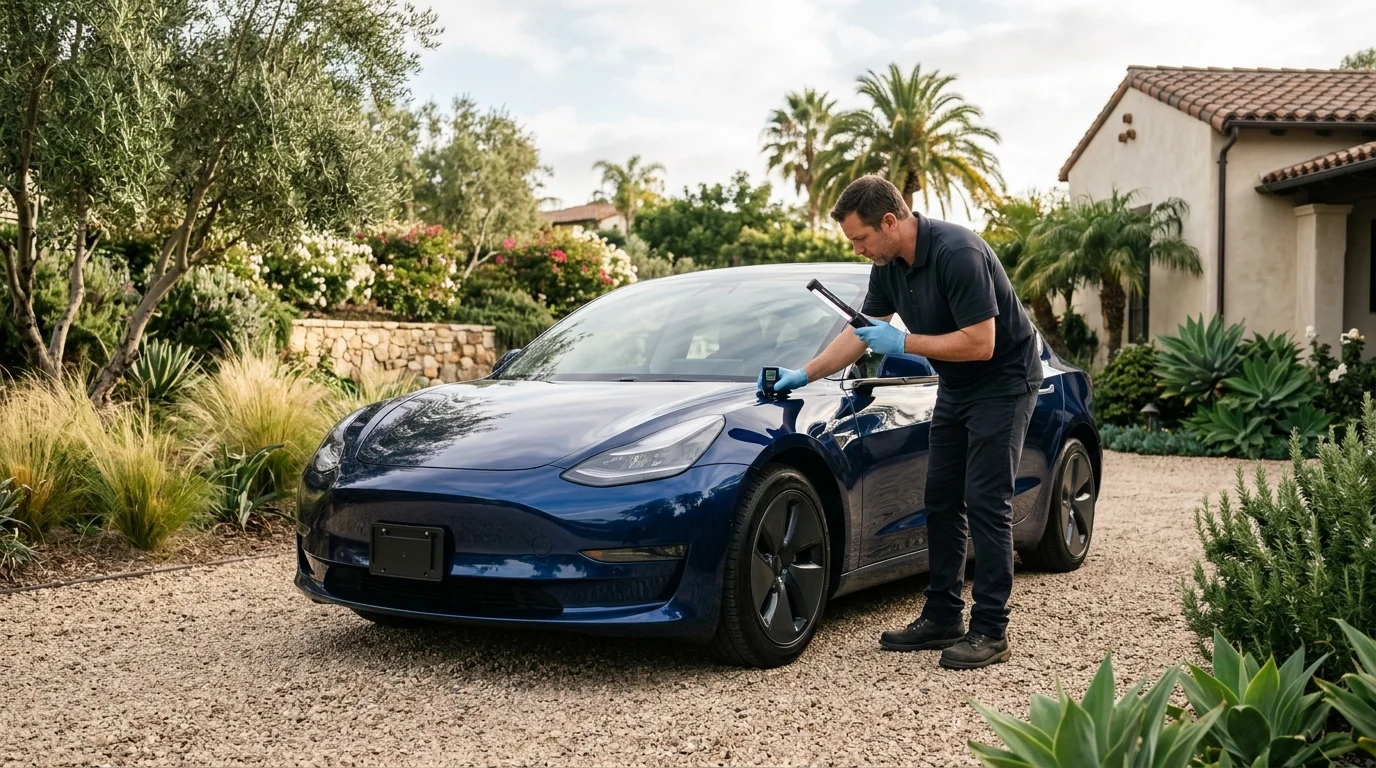
Take the car out of the garage. Park it in open sun on the driveway if the property allows it. If the HOA limits on-site work, use a quiet pull-off after you leave the gate, still in hard light. Walk the hood, roof, and rear quarters at a low angle. Swirl marks look like a spiderweb. Water spots sit as dull rings. Oxidation reads as chalky haze, strongest on the panels that bake all afternoon.
A shaded porte-cochere hides that map. So does a dark bay. The detailing specialist we connect you with should inspect in bright light, and often with a handheld lamp on darker colors. Phone photos from inside a garage are a start. They are not the assessment.
Look at panel edges and around badges. Open the fuel door and check the paint behind it. Those quieter spots show how the rest of the car was washed. If the center of the hood is cloudy and the edges are clearer, the damage is likely wash-related. A full respray or a failed clear coat looks different: uneven texture, a ridge at a tape line, or dullness that does not change with the angle of the sun.
Rancho Santa Fe sits inland of Del Mar. The marine layer is thinner here. Paint spends more hours in hard sun. That is why a coastal correction inspection in Del Mar and an inland walk-around are not the same job. Salt film is less of the story on these ridges. Heat, dust from ranch roads off Del Dios Highway, and eucalyptus sap on warm clear coat are more of it.
Do not decide the job from one photo. Paint correction is machine polishing that can improve swirl marks, water spots, light scratches, and oxidation in the clear coat. The installer assesses the paint and quotes the safe stage before any coating or film. That is a description of the referred trade. It is not a guaranteed finish.
How wash marks and deeper damage differ
Most of what owners call scratches on a daily driver are wash marks in the clear coat. Rotary brushes, dirty mitts, and dry wiping leave fine circular trails. Those often respond to machine polishing. Deeper damage is a different class. A key gouge that catches a fingernail, a rock chip through color, or cracked clear coat will not polish back to factory color.
Which scratches buff out depends on depth. If color or primer shows, polishing will not restore the panel. Conventional repair and refinishing sit outside a correction quote. The pro should say so before anyone turns a machine on.
Clay bar is not correction. Clay is a decontamination step after a wash. It pulls bonded fallout so the surface feels smooth. It does not remove swirls. Do not clay a coated car without the installer’s advice. After a proper wash and clay, the true defect map is easier to read, and the quote should change if the paint was only dirty, not marked.
Wet sanding versus machine polishing is a separate decision. Wet sanding is more aggressive. It is not a default stage on every hood in the Covenant. The installer confirms whether the remaining clear coat can take it. There is no fixed number of polishing stages that fits every SUV, and no promised mirror finish.
A “full” paint correction is a scope term, not a factory spec. In this trade it usually means the pro will work more of the paint, often with more than a light polish, after checking what is safe. Ask what panels are in, what defect types they will chase, and what the stop point is if the clear coat is thin. A light polish on a new car and a heavy cut on an oxidized roof are not the same ticket.
Paint correction in this market typically runs $300 to $1,200 depending on vehicle size and defect severity. Your installer confirms the written price. That range is not a bid for a long-wheelbase SUV with years of brush-wash haze.
Why gated parking and inland sun change the inspection
Many Rancho Santa Fe properties sit behind gates. Guest lists, time windows, and association rules are not uniform. Do not assume every estate or HOA allows the same setup: a generator, a water tank, or a full-day polish in the motor court. Ask the pro where the work happens. Some jobs stay at a shop. Some owners want the car picked up. Access is part of the inspection, not an afterthought.
Inland sun changes what you see and when you see it. Morning shade under oaks can hide haze that 2 p.m. light on a south-facing driveway will not. Horizontal panels on Del Dios Highway miles pick up dust that bonds when the clear coat is hot. Bird droppings and sap etch faster on a warm hood than they do in a cool coastal garage.
Parked under eucalyptus, look for etched dots and sticky film that a normal wash did not move. That is contamination and possible clear-coat damage, not just dirt. The pro should wash and decontaminate before judging how much polish is even in play. Ranch-road dust and unpaved drive spurs add a fine grit coastal lots rarely see. It sits in the clear coat and reads as roughness until it is removed.
Gated, tree-lined parking also means uneven fade. One flank of a car can live in shade while the roof cooks. A quote that treats every panel as identical is incomplete. The written assessment should call out the hood, roof, and any resprayed bumper separately.
Water and power on site are the pro’s to confirm at booking. Getting matched costs you nothing. Same-week scheduling is available for most services. That is a scheduling note. It is not a promise the machine work happens in your driveway, and it is not a same-day claim.
If the car lives near Fairbanks Ranch or along Via de la Valle, say so in the notes. Commute miles, tree cover, and gate timing all change how long the inspection takes and where the polisher can run.
When correction should come before coating or film
Coating locks in what is already there. Film covers it. If you want ceramic coating in Rancho Santa Fe, the finish under it should be the finish you can live with. Paint correction before ceramic coating is the normal order when swirls and light oxidation are in the clear coat.
Ceramic coating is a liquid polymer that bonds to paint and leaves a hard, hydrophobic layer. It resists water, UV, and light chemical exposure. It does not absorb rock chips. Paint protection film is a flexible thermoplastic film that shields paint from chips, scratches, and road debris. Minor surface marks on some films can relax with heat. Neither product is a substitute for safe polishing when the clear coat is already marked.
A new car still gets an inspection. Dealer prep and transport can leave wash marring. The installer looks first, then quotes. If the paint is already coated, the pro decides whether that layer comes off, stays, or rules out aggressive work. Clay on a coated car without that advice is a bad shortcut.
Aftermarket products generally cannot void a factory warranty merely because they were used, under the federal Magnuson-Moss Warranty Act as the FTC explains it. Causation is still fact-specific. That is not advice on a warranty dispute. Confirm the product plan with your installer in writing.
Correction before film matters on the front end if Via de la Valle and I-5 miles are in the weekly mix. Polish first, then film, so you are not trapping haze under a clear bra. The installer inspects first because failing or previously resprayed paint is the risk case for removal later. Professional removal on healthy factory paint is the normal case.
Ceramic coating typically runs $500 to $3,000. Paint protection film typically runs $800 to $8,000. Your installer confirms the written price. Correction that runs long can add days before those layers go on. Ceramic coating is typically 1 to 2 days, with extra days when correction is included. That is an expectation, never a scheduling guarantee.
What to put in the written scope
Ask for a written quote after the in-person look. Getting matched costs you nothing. You contract and pay the installer you choose. The brand does not set the rate and does not do the polishing.
Put these items in the scope. Vehicle, color, and which panels are in. Photos of the hood in sun, plus any chips or cracked clear. Whether the goal is correction only, correction then coating, or correction then film. Where the car will sit during the job, including gate timing or a shop drop. Who confirms water, power, and parking if any work is on site.
Ask the pro to name the defect types they will address: swirl marks, water spots, light scratches, oxidation. Ask them to name what they will not: through-color scratches, bumper scuffs with cracked paint, or stretched metal. Paint correction is machine polishing of the clear coat. It is not bodywork.
Ask how they will judge a safe stop. A depth reading on a thin European clear coat is a reason to slow down, not a reason to invent a stage count. If wet sanding is on the table, it should be written as an option with a yes or no after the inspection, not as a default.
Ask for the care sheet after any coating. Avoid brush tunnels. Follow the installed product sheet for soap, chemicals, and timing. Do not assume carnauba wax belongs on a coating. Compatible maintenance toppers only.
If graphene comes up as a label next to ceramic, treat it as a marketing name. Comparison pages disagree. Ask for the product data sheet and the written warranty. Do not buy a story about it being stronger or longer lasting.
A “full” correction should list panels, defect types, and the next layer (coating, film, or neither). If those lines are missing, the quote is not done. Read it in the same sun you used on the driveway.
When to call us
If the hood lights up with wash marks in Rancho Santa Fe sun, or you want coating or film over paint that still looks tired, get a pro to inspect before anyone polishes. Call us at (760) 400-6557 and we’ll connect you with a vetted, insured local pro.