Bright Del Mar sun is the cheapest inspection tool you have. Swirls, haze, and water spots that look fine in a garage jump out on Camino Del Mar at noon. Auto paint correction in Del Mar starts with that look, not with a pad on the paint.
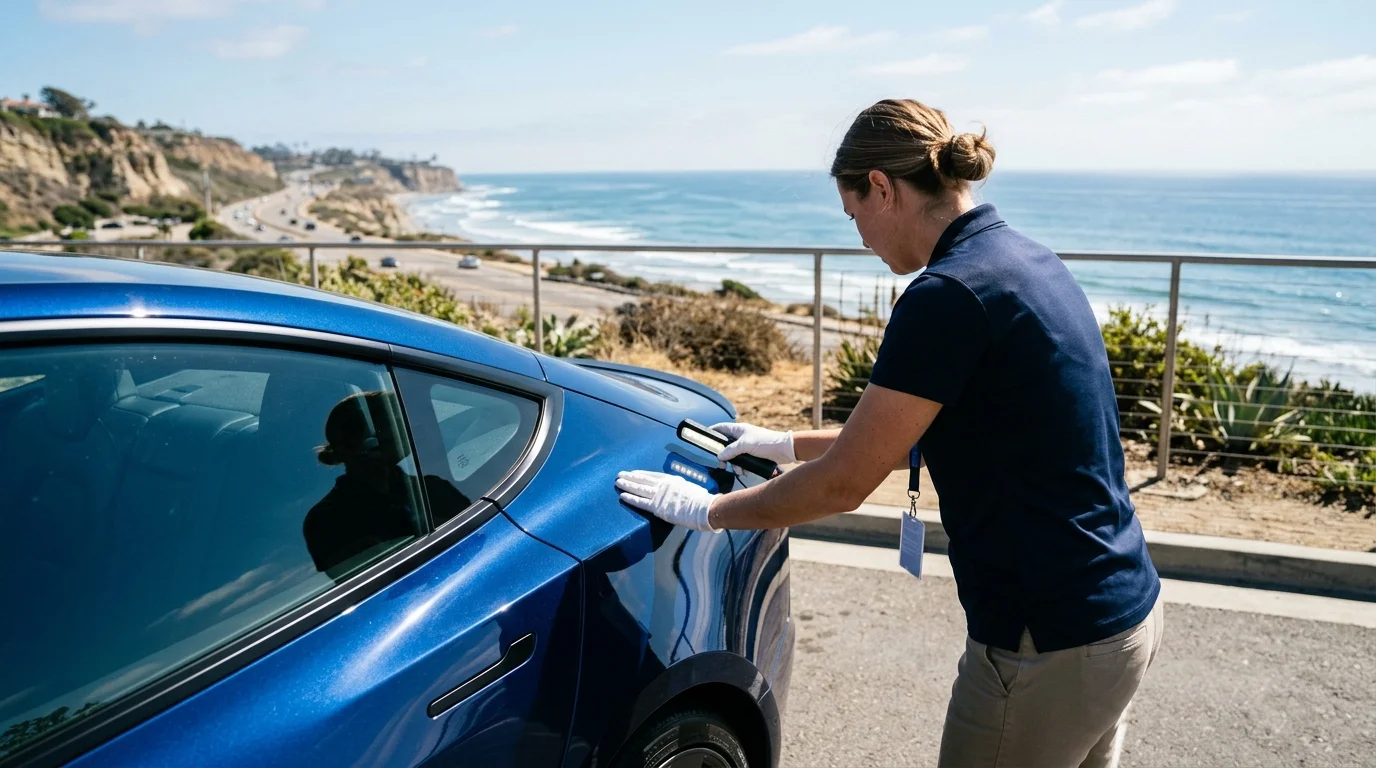
Start with what the paint shows in direct sun
Take the car into open light. Shade hides haze. Overhead LEDs hide holograms. Coastal sun on a clean, dry panel is the honest view.
Park where you can walk the whole car. A lot off Via de la Valle, a street in Olde Del Mar, or your own driveway in Del Mar Heights all work if the sun is on the paint. Look along the shoulder line, not straight down at the hood. Horizontal panels collect wash marks. Vertical doors pick up parking scuffs. The roof and trunk lid often tell the wash story first.
What you are looking for is specific:
- Fine spiderwebs that follow a circular wash path
- Dull patches on the hood, roof, and deck lid
- Water-spot rings that stay after a dry wipe
- Isolated lines from a bush, zipper, key, or bike
- Chips that show primer, color, or bare metal
If the paint still feels rough after a careful wash, that is often bonded fallout, not a scratch. A clay bar is a decontamination step, not paint correction. Clay comes after a wash and before machine work. Do not clay a coated car without the installer’s advice.
Paint correction is machine polishing. It can improve swirl marks, water spots, light scratches, and oxidation in the clear coat. It is not a respray. It does not replace color. It does not fill a chip that already went through the clear. The installer assesses the paint and quotes the safe stage before any coating or film.
Bring the car as clean as you can. Dirt disguises defects. If you only have time for one look, do it after a careful hand wash, in sun, with the panel dry. A phone photo is a start. It is not a thickness reading. The pro still has to see the car in person before anyone turns on a machine.
People searching for the best paint correction services Del Mar CA often skip this step. They book a polish, then argue about what never came out. The sun check is how you know what you are actually buying.
How wash marks and deeper damage differ
Wash marks sit in the clear coat. They look like a web of fine circles under the sun. Automatic brush tunnels and dirty drying towels make them. So do rushed driveway washes with one grit-loaded sponge. Those marks are the usual case for machine polishing.
Deeper damage is a different job. A scratch that catches your fingernail may still be in the clear, or it may already be in the color. A chip with a pale or metal center is not a polish problem. Cracked paint, stretched metal, and plastic bumper scuffs typically need conventional repair and refinishing instead. Paint correction does not repaint a panel.
Which scratches actually polish out depends on depth, location, and how much clear coat is left. That is why a serious quote starts with an inspection, not a package name. A one-pass “buff” is not the same as staged correction. Buffing is a vague word. Correction is assessed machine work with a compound and polish the installer chooses for that paint.
Wet sanding is more aggressive still. Some defects need it. Many do not. Wet sanding versus machine polishing is a method choice, not a sales upgrade. Ask the pro to say, in writing, whether they plan to sand and which panels they would touch.
Oxidation is its own look. The finish goes chalky or flat, often on the roof and hood of a car that lives outside. Light oxidation in the clear coat can improve with polishing. Heavy fade, peeling clear, or a respray that is already failing is past correction. The honest next step then is bodywork, not a longer polish cycle.
Rock chips from I-5, the 101, or the Fairgrounds traffic on Jimmy Durante Boulevard also get mixed into “scratch” talk. A chip is missing film and color. Polishing around it can make the halo less obvious. It cannot put the chip back. If the paint is broken, say so in the scope and keep correction honest.
Why Del Mar parking and driving history matter
Del Mar is not one parking pattern. A car that lives in a garage off Camino Del Mar does not age like a car that sits open near the village, the Beach Colony, or the lots by the racetrack. Salt air, marine layer, and sand from beach days can dull a finish faster than an inland commute. That is a local condition, not a diagnosis of your specific car. Not every Del Mar vehicle shows the same damage.
Ask yourself where the car actually spends the week. Street parking in Olde Del Mar is tight. Door dings and bumper taps show up on the sides. Those are often dent or refinish questions, not polish questions. If the paint is intact and the panel is accessible, paintless dent repair may fit. Cracked paint does not.
Coastal parking also leaves grit. Sand from River Mouth and family beach days rides home on sills, carpets, and the lower body. On the paint, that grit turns a sloppy wash into new swirls. If the last “correction” faded after a few brush-tunnel washes, the wash habit is the problem. Correction without a better wash plan just starts the clock again.
Driving history matters as much as the zip code. Via de la Valle to I-5 is a chip zone when traffic is packed. Torrey Pines grades and the 101 collect bugs and film on the nose. A weekend car that only comes out for racing season at the Fairgrounds may look great on the sides and tired on the hood. A school-run SUV from Del Mar Heights may be the opposite: clean nose, washed-to-death doors.
Tell the installer the truth about washes, parking, and prior work. A dealer “protection” package, an old coating, or a wrap changes what is safe to polish. Failing or previously resprayed paint is the risk case, which is why the installer inspects first. Auto paint correction services Del Mar CA should follow that car, not a generic coastal script.
When correction should come before coating or film
If you are about to coat or film the car, inspect and correct first. A ceramic coating is a liquid polymer that bonds to paint and creates a hard, hydrophobic surface layer. It resists water, UV, and light chemical exposure. It does not absorb rock chips. It also locks in whatever is under it. Swirls under a coating are still swirls, only shinier and harder to revisit.
That is why paint correction before a ceramic coating is the normal order. The installer assesses paint and quotes the safe stage before any coating. Extra days are common when correction is included with a coating job. Ceramic coating work in this market typically runs 1 to 2 days, and the installer confirms the schedule. Same-week scheduling is available for most services. That is not a same-day promise.
Paint protection film is a different product. It is a flexible thermoplastic film that physically shields paint from chips, scratches, and road debris. Some films can self-heal minor surface marks with heat. They do not heal punctures, deep damage, or bad paint underneath. Existing wax or coating can interfere with film adhesion. The film installer specifies prep. If the hood already looks milky in the sun, film will not hide that. Correct, then cover the panels you actually want shielded. Read more about ceramic coating in Del Mar when protection is the next step after the polish.
Is correction worth it on its own? It can be, when the defects are in the clear coat and you want the finish clearer now. It is a poor spend when the clear is failing, the color is gone, or you will put the car straight back through a brush tunnel. How long a correction “lasts” is not a published year figure we can stand behind. Polishing removes a thin amount of clear. It does not add a layer. New wash marks return if the wash method stays the same. A coating or film after the work is how many owners slow that down. Follow the product care sheet the installer gives you. Avoid brush tunnels. Do not assume carnauba wax belongs on a coating.
A federal aftermarket-parts rule is worth knowing if a dealer later blames a coating or film. Under the Magnuson-Moss Warranty Act, enforced by the FTC, a vehicle manufacturer generally cannot void a warranty merely because an aftermarket product was used, unless that product caused the failure. That is not a promise that your warranty is protected. Causation is fact-specific. Do not treat this as advice on a dispute.
What to put in the written scope
A useful quote for auto paint correction in Del Mar is a scope, not a nickname. “Full correction” means nothing until it lists panels, methods, and what will still be there when the machine stops.
Ask the installer to write down:
- Which panels are in, and which are out
- The lighting they will inspect under, including sun and a handheld lamp
- Whether they will clay, and that clay is decontamination, not correction
- Machine polishing stages they expect, and whether wet sanding is on the table
- Defects they believe will improve, versus chips, dents, and broken paint they will leave
- Whether ceramic coating or paint protection film follows on the same visit
- The written price, with vehicle size and defect severity as the drivers
Paint correction in this market typically runs $300 to $1,200 depending on vehicle size and defect severity. Your installer confirms the written price. Ceramic coating typically runs $500 to $3,000. PPF typically runs $800 to $8,000. Those are ranges, not a bid for your car. Getting matched costs you nothing. The in-person assessment and written quote cost you nothing. You pay the installer you choose for the work.
Push back on language you cannot verify. No hardness ratings. No “permanent” shine. No year-long durability claim for the polish itself. No product brand names on this referral. The product tier is whatever your installer recommends and puts in writing.
If the car needs refinishing, say so and stop. Correction is not a cheap respray. If the car needs film on the nose because you run Camino Del Mar to the freeway every weekday, put that in the same conversation so you do not polish a hood you were about to cover without agreeing on prep.
Bring notes from your sun walk. Point at the roof, the driver’s door, and the bumper in daylight. Independent, vetted, insured local pros do the work. Paint Shield SD matches you with them. We do not polish, coat, or film the car ourselves.
When to call us
Call when the sun already showed swirls, haze, or light scratches, and you want a written scope before coating or film, not a guess on a pad. That is the moment for a professional ceramic coating and paint protection film pro, not a wash-and-wax. Call us at (760) 400-6557 and we’ll connect you with a vetted, insured local pro.