You can see paint protection film, but usually not by staring at the middle of a panel. Clear bra, the same product, is meant to disappear. The useful clues are an edge, a tucked wrap, a seam at a gap, or an installation invoice that names film instead of a generic “paint protection” package.
A thin line near a hood edge is often the clearest clue. Check the car under angled light, then feel gently for a transparent layer. Wrapped film edges may sit behind the panel, so a blank-looking hood is not proof the car has no PPF.
Water beading after a rinse is not proof of film. Wax and ceramic coating can make paint look just as slick. Film is a physical layer with an edge you can see, feel, or find in paperwork.
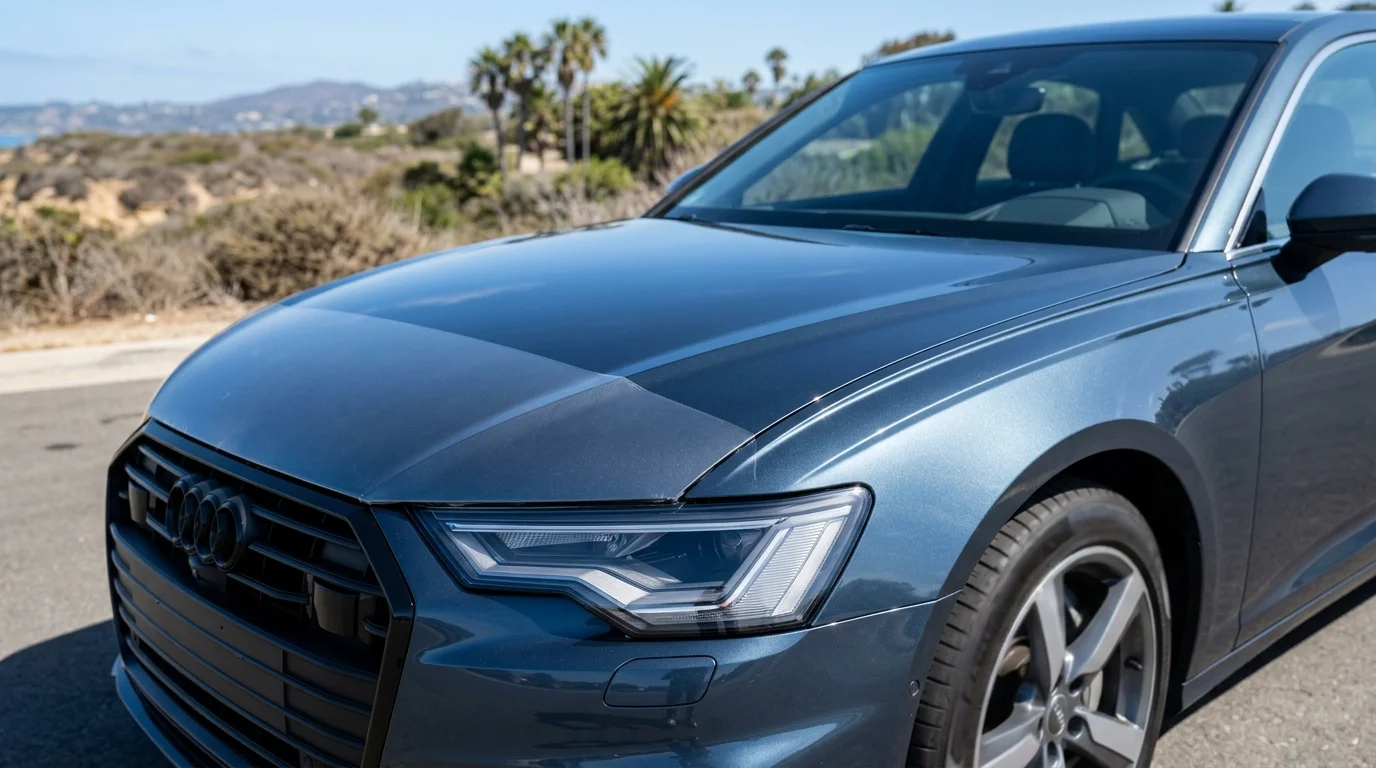
The fingernail and edge test
Start with a clean, dry panel. Dirt can hide an edge or create a false one. Don’t use a blade, scraper, or anything sharp.
Run the soft pad of your finger across the hood. Begin near the front, then move toward the windshield. Partial hood coverage may leave a fine horizontal line across the paint. You may feel a slight step where the film ends.
Use your fingernail only as a light probe. Move it across the suspected line without digging underneath. If your nail catches gently, you may have found a film edge. Don’t pick at it. Lifting a corner can introduce dirt or make an existing problem worse.
Next, inspect the places installers commonly cover:
- The leading edge of the hood
- Front fenders
- Front bumper
- Side mirrors
- Door handle cups
- Rocker panels
- Headlights
Coverage can differ from panel to panel. A car might have film on its bumper and mirrors but not its hood. Another might have a partial hood section instead of complete panel coverage.
Open the hood and study its underside near the outer lip. Some installations wrap film around that edge. You may see or feel the termination point behind the panel. Other installations stop short of the edge, making the boundary easier to find from above.
Don’t rely on touch alone. Wax, coating, body repairs, and surface contamination can change how paint feels. A clean comparison between a protected panel and an adjacent unprotected panel gives you better evidence.
If you still can’t find an edge, that doesn’t prove the car lacks PPF or clear bra. A detailing specialist can inspect tucked edges and confirm which panels have film.
Looking for cut lines at panel gaps
Panel gaps offer another useful inspection point. Look where the hood meets each fender, around the bumper, and along mirror housings. Transparent film may stop just before a gap or continue around the panel edge.
Use a flashlight and view each gap from several angles. You’re looking for a second, extremely thin boundary above the painted surface. Dust or residue sometimes gathers along that boundary and makes it easier to see.
Curved areas deserve extra attention. Check bumper openings, parking sensor areas, and the corners of mirrors. Film has to follow those shapes, so small seams or relief cuts may be visible. A seam alone doesn’t tell you whether the installation is good or bad. It only helps establish that film is present.
A straight line across the hood usually suggests partial coverage. Complete hood coverage may have edges tucked underneath. Compare both sides because PPF coverage isn’t always symmetrical, especially after a panel repair.
Don’t mistake these features for PPF:
- A paint blend line from prior bodywork
- The edge of a vinyl stripe or decal
- Dried polish around trim
- Clear tape or temporary transport material
- A reflection from the panel’s body line
Change your viewing angle before reaching a conclusion. A real film edge stays attached to the same spot as you move. A reflection shifts with the light.
Dealer paperwork can settle the question faster. If a sales document says “paint protection,” ask whether that means physical film or another surface treatment. The wording alone doesn’t identify the product. Request the original invoice and a panel-by-panel coverage list.
Our paint protection film service guide explains common coverage options and what to discuss with a local installer.
How film reads differently under a flashlight
Transparent film can disappear under flat daylight. A flashlight placed low against the panel makes subtle changes easier to see.
Park in a shaded garage or another dim area. Hold the light near the paint instead of pointing it straight down. Sweep it slowly across the panel. Watch the reflected beam as it crosses the suspected film edge.
PPF, or clear bra, may show a small change in texture, gloss, or reflection. The transition is usually easier to notice when one part of the panel is covered and the other isn’t. Compare the same reflection on both sides of the line.
Factory paint also has texture. Repainted panels can reflect light differently from original panels. Don’t label every change as film. Confirm it with an edge, seam, or installation record.
Look across the panel rather than directly into it. This low viewing angle can reveal:
- A narrow line at the film boundary
- Slight haze within one section
- Fine debris near an exposed edge
- A lifted corner
- A texture change between covered and uncovered paint
Water behavior isn’t reliable proof. Wax, ceramic coating, spray sealant, and fresh detailing products can all change how water moves. A coated film surface may behave much like coated bare paint.
Be especially careful before machine polishing an uncertain panel. Tell the detailing specialist that PPF may be present. They can identify the surface before recommending any work. If the exposed paint needs attention, review the role of professional paint correction with the pro first.
San Diego lighting can complicate the inspection. Marine-layer light around Oceanside or La Jolla can flatten reflections. Harsh overhead sun in El Cajon can create distracting glare. Shade, garage lighting, or an angled handheld light usually gives you a clearer view.
How film differs from a ceramic coating on a used car
On a used car, shine is a poor test. Ceramic coating is a thin liquid bonded to the paint. It can bead water. It is not a sheet you can catch with a fingernail. PPF and clear bra are the same product class. Both are a transparent film with a start and an end.
A dealer package labeled “paint protection” might be either product, or neither. Look for an edge, a tucked wrap, or paperwork that names film and lists panels. Coating does not absorb rock chips. Film is the physical layer for that job. If you only see beading after a rinse, you have not confirmed film.
The two jobs are compared in ceramic coating vs paint protection film. Common coverage options are on the paint protection film service page. Ask a local installer to confirm what is on the car before you buy or polish it.
Why it matters on a used car you are buying
Existing PPF, also called clear bra, changes how you should inspect a used vehicle. You need to evaluate the film and the paint beneath it as separate surfaces.
Begin in daylight before signing paperwork. Walk around the car slowly and record which panels appear covered. Check the hood, bumper, fenders, mirrors, rocker panels, and door edges. Take close photos of every visible seam or lifted area.
Ask the seller or dealer for:
- The installation invoice
- The installation date
- A list of covered panels
- Written product information
- Written warranty terms
- Records of any film removal or replacement
- Details about repainted or repaired panels
Don’t assume warranty coverage transfers with the car. The installer or product provider should confirm the current terms in writing. A universal film warranty length couldn’t be confirmed from the approved information for this site.
The phrase “dealer-applied paint protection” isn’t specific enough. It might describe film, a liquid treatment, or another dealer product. Ask the dealer to identify exactly what was applied and where. If they can’t confirm it, treat the protection type as unknown.
Film can also complicate a paint inspection. Marks may sit on top of the film, within it, or beneath it. A cloudy area might involve the film rather than the clear coat. An imperfection beneath transparent film could predate the installation. A detailing specialist needs to inspect the layers before recommending correction or replacement.
This matters across San Diego County, where used vehicles may have very different driving histories. An Interstate 5 commuter and an inland Interstate 15 commuter may show wear in different places. Geography alone doesn’t prove anything, so inspect the actual car and its records.
If you’re deciding whether existing coverage adds value for your driving needs, read whether PPF is worth it in San Diego. Base your decision on film condition, covered panels, and documentation.
What to do if the film is old
You can’t determine a film’s exact age by appearance alone. The original invoice is the best starting point. If no paperwork exists, ask a detailing specialist to evaluate its condition.
Inspect each covered panel for visible changes. Common reasons to request a professional assessment include:
- Edges that are lifting or collecting dirt
- Cloudy or uneven sections
- Cracks within the film
- Noticeable discoloration
- Seams that have shifted
- Damage exposing the paint below
- Different film appearance across adjacent panels
Don’t pull an edge to see what happens underneath. Removal results can depend on the paint’s condition, prior repairs, and how the film was applied. A pro should inspect the panel before removal begins.
Old-looking film doesn’t automatically mean damaged paint. Likewise, glossy film doesn’t confirm that everything underneath is perfect. Transparent material can make the layers difficult to judge from a driveway inspection.
Ask the pro to identify three things: which panels have PPF, whether the current film should remain, and what the paint may need after removal. Get the film warranty and proposed scope in writing.
There isn’t a verified universal replacement interval that fits every film and vehicle. Don’t accept an unsupported lifespan claim based only on appearance. Check the original product paperwork, then have the installer confirm the recommendation.
If replacement makes sense, decide whether to repeat the existing coverage or change it. Front-impact areas may need a different plan than doors, rocker panels, or a complete body. The installer can explain the available coverage and confirm a written quote.
When to call us
Call when you can’t confirm an edge, the film looks damaged, or you’re considering removal. Paint Shield SD matches car owners with vetted, insured local pros.
Call us at (760) 400-6557 and we’ll connect you with a vetted, insured local pro.