A crease dent can often be fixed with paintless dent repair if the paint is intact, the back of the panel can be reached, and the metal is not torn. A crease is a line of work-hardened metal, not a round ding. A local pro has to inspect the actual panel. Do not diagnose a crease from a photo.
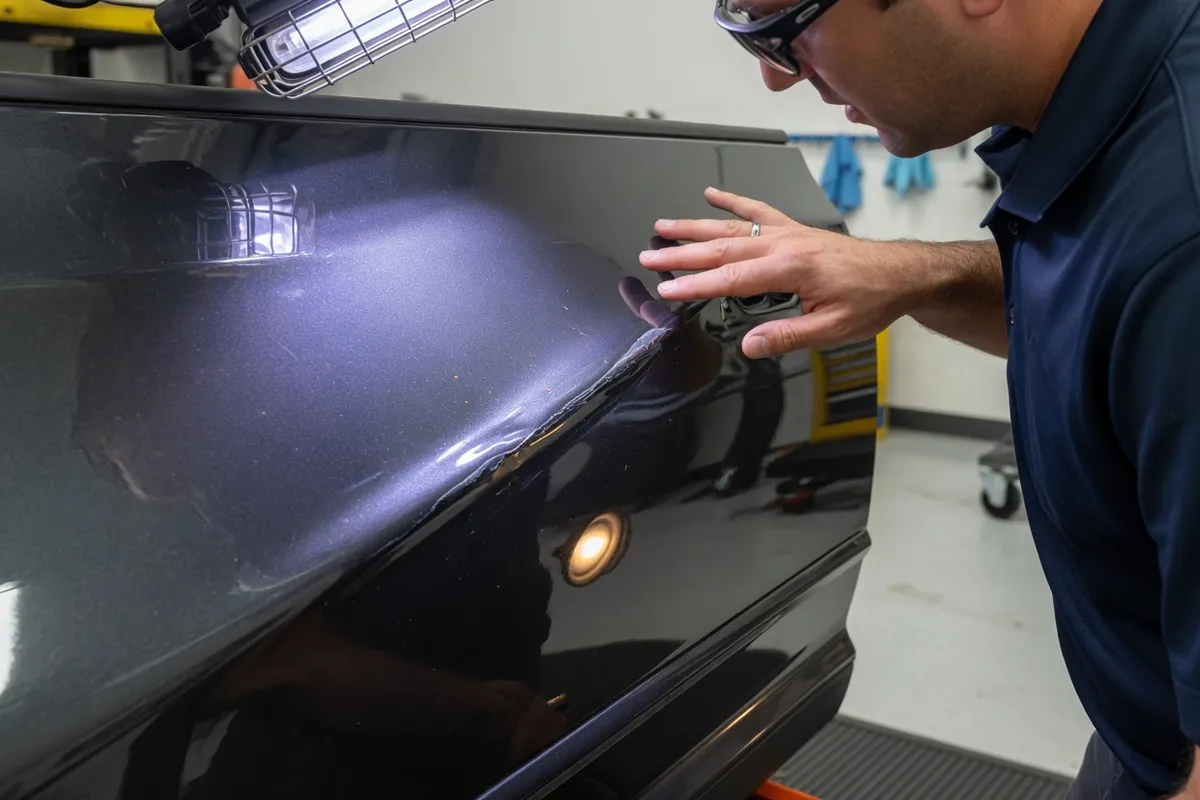
Why crease shape matters more than size alone
A round parking ding is a bowl. The metal dips at one point and the stress spreads around it. A crease is a fold. Something dragged or pressed along the panel and left a line. That line is the repair, not the length of the mark by itself.
Along that fold the metal has been worked harder than the metal beside it. Technicians call that work hardening. The stiffest part of the damage is the crease itself, which is why a short, sharp line can take longer than a larger, shallow ding on the same door.
Size still matters, but it answers the wrong first question. A six-inch crease on a flat door skin is one problem. The same length on a factory body line is another, because that raised edge has to come back as a line, not a smooth patch. A shallow cart mark across the middle of a door is not the same job as a tight fold next to a handle or a door edge.
San Diego parking makes this shape common. A neighboring door in a UTC or Fashion Valley structure can drag its edge down your panel instead of tapping one round spot. A shopping cart in a Mission Valley or Mira Mesa lot can leave a similar line. Workplace lots along the I-5 and I-15 corridors see the same kind of contact where spaces are tight. None of those settings proves what happened to your car.
Look across the panel, not only straight at it. Notice whether the fold is sharp or rounded, whether it sits on a body line, and whether the metal around it looks raised. Those details belong with the pro. They do not replace an inspection.
The broader screening still applies: intact paint, and a path to the damage. Our guide to whether a dent is a paintless dent repair candidate covers that test.
How paint condition changes the repair path
Paintless crease dent repair keeps the factory finish only when that finish survived the impact. The method reshapes metal. It does not replace cracked, chipped, or missing paint.
A crease puts extra stress on the clear coat along the fold. A line that looks like “just a dent” from five feet can show a hairline crack up close. If the finish has already split, moving the metal can open that split further. The shape might still improve. The paint will not heal.
Check the line in shade, then in even light. Noon glare in an open Kearny Mesa or Chula Vista lot can hide a crack. A wet panel after a marine-layer morning in Point Loma can hide it too. Do not pick at a loose edge to test it.
If you can see primer, color loss, or a break in the clear coat along the crease, say so when you request a match. Do not ask only for “dent removal.” That wording can produce a paintless-only quote that ignores the finish. Dents with chipped paint need a separate refinishing decision, even when the metal might still move.
Prior paint work, film, a wrap, or a coating belongs in that same conversation. Tell the matched pro what is on the surface so they can decide whether paintless dent repair still fits.
Why panel material and access matter
The crease on the paint is only half the job. Material and access decide the rest.
Access decides whether the technician can work the line from behind, or has to evaluate another method from the outside. Door skins are often workable once inner trim is considered. A crease over a brace, a glued reinforcement, or a sealed cavity may not give a clean path. The pro confirms that on the car, not from a thumbnail.
Panel material changes the technique even when the crease looks identical. Steel and aluminum can share the same parking-lot line and still need different tools. This page is not the aluminum science. If the damaged panel may be aluminum, read paintless dent repair on aluminum and have the technician confirm the metal before anyone quotes a method.
Working conditions change around the county even when the metal does not. A shaded driveway in Rancho Bernardo is easier to read than a dark downtown structure or a windy open lot in Otay Mesa. Mobile paintless dent repair exists in this market. Ask your pro whether they offer it. Do not assume a street-side spot is enough space or light. If film is already on the panel, say so. That belongs in the inspection, not in a guess from a photo.
When conventional body repair may be needed
Paintless work is the wrong tool when the paint is already broken, the metal is torn or punctured, the panel has stretched past a usable return, or there is no workable access. Plastic bumper covers are a different material. A crease-looking mark on a bumper is often a scuff or distortion in plastic, and that typically needs conventional repair.
A very sharp crease can also land in a gray area. The metal may move, and the finish may stay intact, while the realistic result is improved rather than invisible. Ask the pro what they can actually restore on this line, under a light, on this panel. If someone quotes an invisible repair from one phone photo, get another look.
Conventional repair and refinishing become the path when reshaping alone will not produce a suitable panel. The matched pro should put that fork in writing before work starts: what is included, what is not, and what would pause the job if more damage shows up behind the panel.
Insurance is a separate question. Many body repair pros work with claims. Coverage and premium effects are questions for your insurer and your policy. Ask the pro whether they work with claims. Getting matched costs you nothing. Same-week scheduling available for most services. Your installer confirms the written price after they see the crease.
What photos and details to share with a pro
Photos help you get matched. They do not diagnose a crease. Send enough context that the pro knows which panel they are looking at, then plan on an in-person look.
Include one image of the whole panel, one close image of the crease in even light, one angled shot of the broken reflection, and one wider shot of where the damage sits on the car.
Add a short description. Name the panel. Say whether the paint looks cracked, chipped, or intact. Mention film, a wrap, a coating, or prior bodywork if you know about it. Neighborhood and setting help more than adjectives. “Driver’s door, line from the handle down, noticed in the UTC garage” is more useful than “pretty sharp crease.”
Ask whether this crease is a paintless candidate, whether they can reach the back of the panel, what result is realistic on this line, and what written price applies after inspection.
Single door dings typically run $75-$350. Larger or multiple dents typically run $300-$900. Creases often take longer than a round ding of similar size, because the line has to be released in small moves rather than lifted as one bowl. This site does not publish a crease-specific dollar figure. Your installer confirms the written price after reviewing the actual damage. Conventional bumper or scratch work is quoted after photos or an in-person look.
You contract with and pay the matched pro directly. Paint Shield SD does not set the repair price and does not perform the work.
A crease can often come out without paint when the finish is intact, the metal is not torn, and the technician can reach the panel. The shape of the line, not its size, is what the pro is judging. Call (760) 400-6557 and we’ll connect you with a vetted, insured local pro.