Yes, you can do paintless dent repair on aluminum. The paint must be intact, the metal can’t be badly stretched, and the technician needs a workable path to the dent.
Why aluminum behaves differently than steel
Aluminum and steel can show the same shallow door ding. They don’t respond the same way beneath the paint.
The technician must confirm the material before choosing tools or a repair method. This site does not publish a universal claim about how aluminum moves, work-hardens, transfers heat, or should be heated because no single procedure fits every panel and dent.
The basic eligibility questions remain familiar. Is the paint intact? Has the impact stretched the metal? Can the technician reach the back of the panel, or use another suitable method from the outside? Our paintless dent repair service helps San Diego drivers connect with a pro who can answer those questions in person.
A shallow ding from a North Park parking space may be a good candidate. A sharp Mission Valley shopping-cart crease may need closer inspection. The visible size alone doesn’t settle the issue. Panel material, impact shape, paint condition, and access all matter.
The vehicles most likely to have aluminum panels
You can’t identify an aluminum panel from the vehicle’s price or appearance. Many vehicles mix steel, aluminum, plastic, and composite parts across the same body.
Vehicles can mix steel, aluminum, plastic, and composite parts, and the exact construction can change between model years and body styles.
That mixed construction creates an easy mistake. A steel front door and an aluminum rear door can look identical after a parking-lot impact. A replacement panel may also differ from what someone expects based only on the vehicle badge.
San Diego’s vehicle mix makes guessing especially unreliable. A work pickup in East County, an electric commuter near University City, and a performance car in coastal North County may each combine materials differently. Where the vehicle is driven doesn’t reveal what sits beneath its paint.
Don’t rely on an online discussion about a similar model. Look for information tied to the exact year, model, trim, and panel position. Manufacturer repair information is the strongest reference when it’s available. A dealer parts department or collision repair facility may also be able to identify the listed panel material.
Material identification matters before a quote or repair plan. It tells the technician which tools, access methods, and working approach may fit. It also helps prevent an ordinary-looking door ding from being treated like a steel-panel repair without confirmation.
What a tech does differently on an aluminum dent
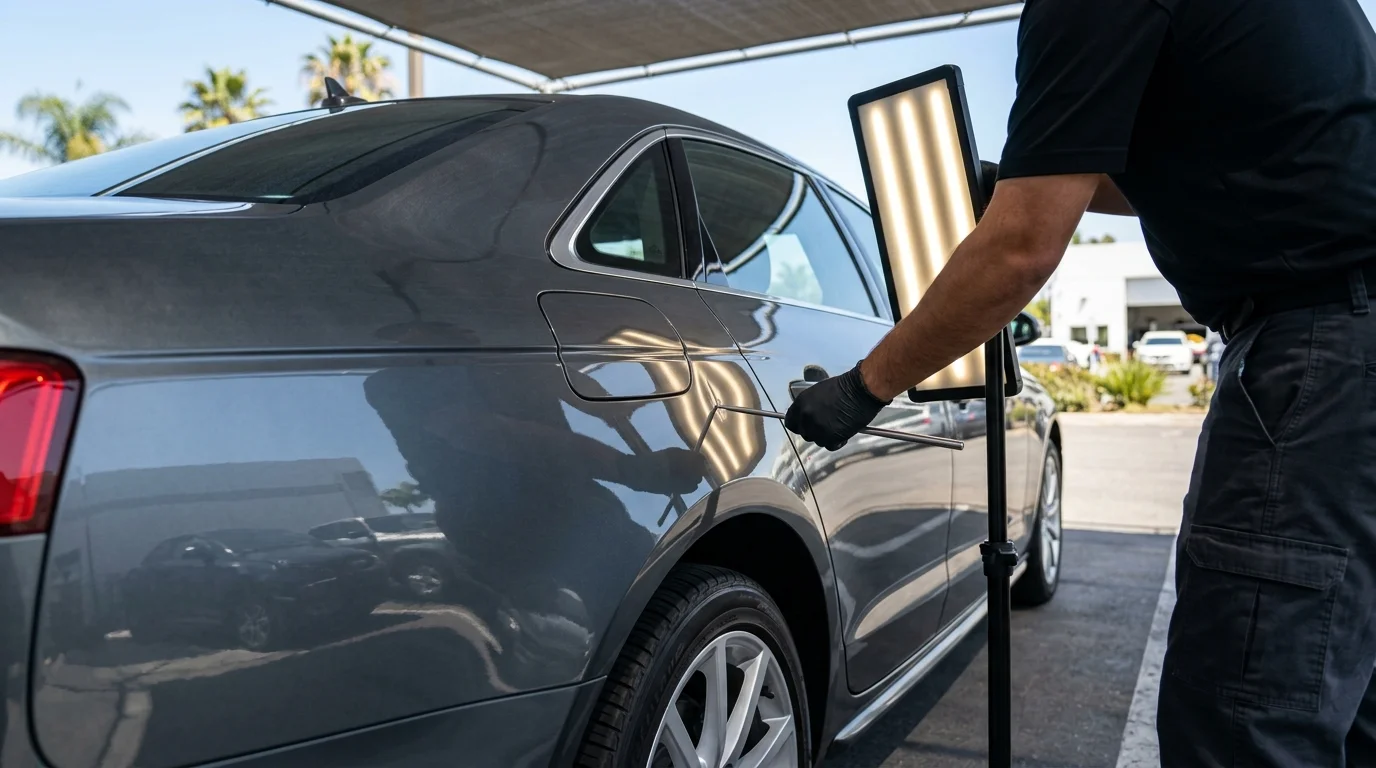
The first difference is verification. A technician should confirm the panel material instead of assuming it from the vehicle model. The dent is then inspected under focused lighting to reveal its center, edges, crowns, and any distortion beyond the obvious low spot.
Ask the technician to explain the proposed access, tools, and any use of heat for this exact panel. If heat is proposed, the pro should explain how the painted surface will be protected.
Access strategy matters just as much. A removable trim panel might provide a path behind a door dent. A hood brace or structural reinforcement can block direct access. The technician may choose an outside pulling method when back-side access isn’t practical.
Outside pulling requires another paint check. The surface must be evaluated before adhesive tabs are applied, especially if the panel may have been repainted. A prior repair can change how the finish responds. The technician should decide whether that method is suitable.
Some technicians keep tools and work areas dedicated to aluminum repairs. Ask how the pro handles aluminum panels and how often they work with the material. The answer should focus on inspection and technique, not a promise made from one photo.
Mobile PDR exists in the San Diego market, but availability varies by provider. If the vehicle is parked in Chula Vista, Sorrento Valley, or another part of the county, ask your pro whether mobile service is offered and whether the location provides enough working space.
When aluminum pushes the job to conventional repair
Aluminum doesn’t automatically rule out PDR. The condition of the dent and paint carries more weight than the metal label alone.
Paintless repair works best when the paint remains intact and the panel is accessible. Cracked paint, stretched metal, or plastic bumper scuffs typically call for conventional repair and refinishing instead. Your pro should assess which method fits the actual damage.
A sharp fold can concentrate stretching into a narrow area. Damage near a reinforced edge may also limit tool access. Deep impacts can affect a wider section than the visible center suggests. These conditions don’t prove that PDR is impossible, but they make an in-person assessment more important.
Existing paint protection film adds another layer to the inspection. The technician needs to see whether the film affects access or an outside pulling method. If film removal is recommended, ask who will handle it and how the protected area will be addressed afterward.
A dent on a body line isn’t an automatic rejection either. Its repairability depends on the line’s shape, the amount of stretching, paint condition, and access behind the panel. Our guide to checking whether a dent is a PDR candidate explains those broader signs.
Conventional repair becomes the better path when reshaping alone won’t produce a suitable result. If the repaired area also needs finish assessment, ask whether paint correction belongs in the later care plan. Paint correction shouldn’t be treated as a substitute for dent repair or refinishing.
How to find out what your panel is made of
Start with the exact vehicle information. Record the model year, make, model, trim, and damaged panel. Then check manufacturer repair information or ask a qualified repair facility to identify the material.
A magnet can provide a quick initial clue. An ordinary magnet generally attracts a steel panel but not an aluminum skin. Use light pressure and place a soft barrier between the magnet and paint.
Treat that result as a screening step, not a final diagnosis. Steel reinforcement behind a non-steel outer panel can affect what you feel. Plastic and composite panels also won’t attract a magnet. A weak or absent pull doesn’t prove that the surface is aluminum.
Panel construction may also change within one vehicle generation. An online chart for a nearby model year may not describe your car. Prior collision work adds another variable because a panel could have been replaced.
A dent technician can combine material checks with the repair inspection. That includes examining the panel edges, accessible back side, tool paths, paint condition, and impact shape. Ask the technician to explain what was identified and how it changes the proposed repair.
Share clear photos before the appointment, but don’t expect photos to settle everything. Include the whole panel, a closer view of the dent, and an angled image showing the reflection. Mention any known repainting, previous collision work, coating, wrap, or paint protection film.
The final decision should come after the pro confirms the material and damage. That keeps the repair plan tied to your actual panel, not a general assumption about aluminum vehicles.
When to call us
Call when an aluminum dent has intact paint, uncertain panel construction, or nearby paint protection film that needs professional assessment. A Ceramic Coating and Paint Protection Film pro can help coordinate the surface-care questions surrounding the dent repair. Call us at (760) 400-6557 and we’ll connect you with a vetted, insured local pro.