Wheel ceramic coating in San Diego is a liquid layer on the surfaces you actually wash: the faces, and sometimes the barrels. It can change how brake dust, salt film, and road grit release during cleaning. It doesn’t stop dust from landing, and it isn’t a caliper refinish. If you want a new caliper color, start with brake caliper paint vs powder coating instead of this page.
The comparison that matters is which surfaces get coated, how they are prepared, and how you drive. An I-15 or I-805 commute loads wheels with brake dust. Parking in La Jolla or Del Mar adds coastal residue. Inland miles through Escondido add dry dust. Those exposures ask different things of the same ceramic coating for wheels.
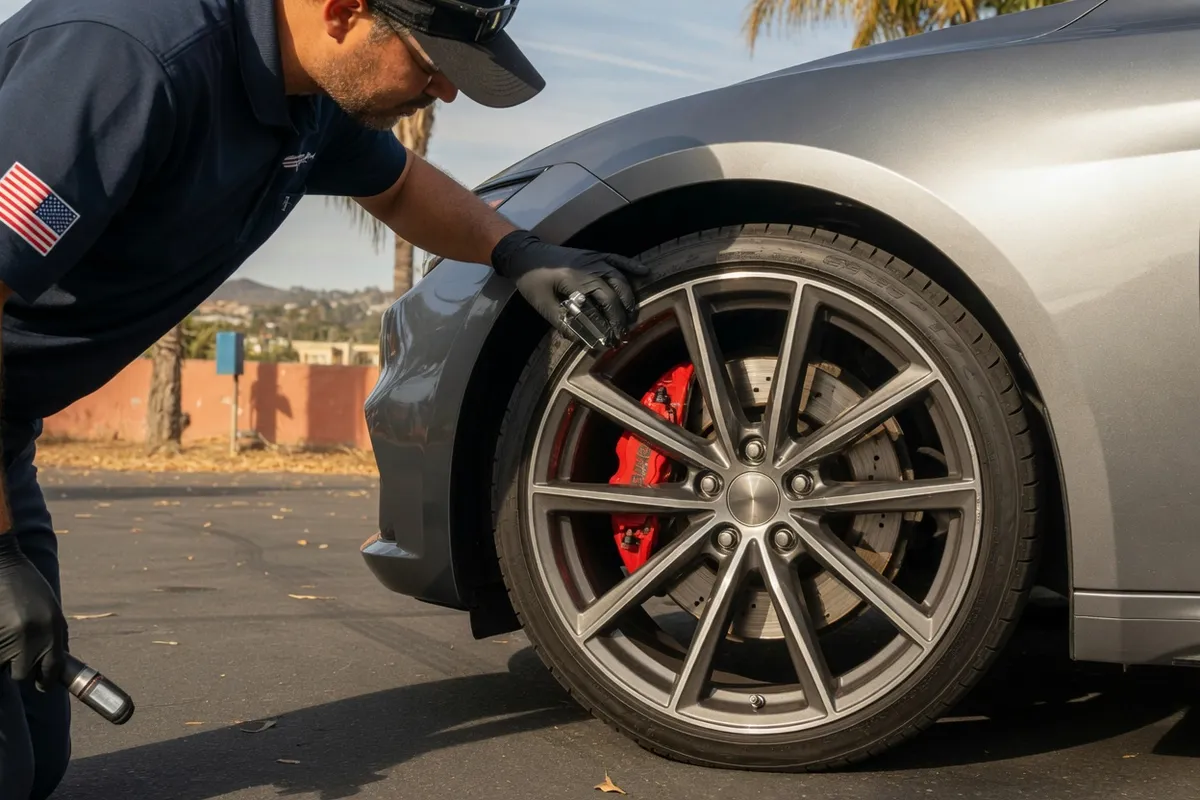
What wheel coating is meant to change
A wheel coating is meant to change the surface that contamination sits on. After prep, the product bonds to the face, and to the barrel if that line is on the quote. Later, some residue may release during a wash instead of biting into bare alloy or neglected paint. That’s a change in release. It isn’t a claim that dust stays off the wheel, and it isn’t a claim that every driver will clean faster.
Brake dust still shows up. Salt still settles. Inland grit still films the inner lip. Results depend on the product, the prep, and the driving. A shop slogan can’t replace those three.
Keep the job on the wheels. Body paint is a separate ceramic coating conversation. Wheel coating San Diego work shouldn’t be sold as a full-car package with a wheel line buried in the fine print.
What the coating isn’t:
- A shield against curb rash, potholes, or rocks
- A filler for pits or peeling clear
- A hardness score, a year rating, or a temperature number
- A per-wheel coupon price
The approved market range for wheel and caliper coating is $300 to $700. That range describes a combined wheels-and-calipers job in this market. It isn’t a face-only price and isn’t a price per wheel. Your installer confirms the written price after inspecting the actual wheels.
Paint Shield SD matches you with a vetted, insured local pro. The wheel and caliper coating service page is the hub. This article stays on the wheel surfaces.
How wheel finish and condition affect the choice
The finish you already have, and the damage already in it, decide whether coating is the next step.
Painted, powder-coated, machined, polished, and clear-coated aftermarket wheels don’t take the same prep. A machined face shows orange-brown staining quickly. A dark painted wheel hides dust until it cakes in the spokes. A polished lip shows water marks and film. Ask the installer to name the finish on your car, not to quote “wheels” as one material.
Condition is the other half of the choice:
- Bonded staining that ordinary soap no longer moves
- Pitting, dull patches, or etching on alloy
- Curb rash, chips, or peeling clear coat
- Old coatings, waxes, or unknown spray products
- Barrel buildup you can’t see with the wheel on the car
Coating doesn’t fill pits. It doesn’t hide rash. It doesn’t glue failing clear back down. If the face is already stained, ask what prep is meant to remove and what will still show once the coating is on. Photos of both faces help. Photos of the barrels help more if the wheels come off.
A late-model wheel with a sound finish is a different quote from a commuter wheel that has never had the barrels cleaned. Don’t let a package name cover that gap. If the installer wants to polish the wheel finish, that’s a separate decision from coating it. Put both on the page.
How coastal residue and inland dust shape upkeep
La Jolla salt, Escondido dust, and I-15 brake dust aren’t the same upkeep problem.
Coastal parking in La Jolla or Del Mar puts salt film and marine moisture on faces and inner lips. Residue that sits through wet-and-dry cycles can be harder to move later. Coating can change how that film releases at the next wash. It doesn’t make a beach-parked car a set-and-forget wheel.
Inland miles around Escondido add dry dust and road grit. That material packs into barrels and spoke backs. A face that looks clean from the sidewalk can still hold a packed barrel.
Commuters on I-15 and I-805 pick up brake dust from stop-and-go and from grades. Dust still lands on a coated wheel. The live question is whether it bonds into the finish or sits where the care sheet’s wash method can move it. Driving decides that as much as the bottle does.
Follow the installed product’s written care directions. Use the soap and method on that sheet. Avoid brush tunnels. A touchless automatic is the safer automatic option when a hand wash isn’t practical. Don’t invent a first-wash wait. The sheet you get at pickup is the rule for your wheels.
Wheel cleaners aren’t all equal. Some are harsher than the coating’s care sheet allows. Ask which products are listed and which to skip. If you lost the sheet, call the installer who applied the coating before you spray anything.
For coated body paint, maintaining a ceramic-coated car in San Diego covers wash method and care-sheet rules. Treat the wheels as their own line on that same sheet, not as an afterthought at the end of a body wash.
What preparation belongs in the written quote
If the quote can’t name faces versus barrels, you’re not comparing the same job.
Prep is the work. The coating is the last step. A useful written quote lists:
- Which wheels, and whether all four are included
- Faces, spokes, barrels, and inner lips as separate coverage lines
- Whether the wheels come off, stay on, or some mix
- Cleaning, iron decontamination, and any polish of the wheel finish
- What will still look stained, pitted, or rashed after prep
- Whether calipers are inside the same price or quoted apart
- The care sheet you receive at pickup
- The written price, which your installer confirms after inspection
Barrel versus face coverage is a quote line, not a guarantee. Coating the faces with the wheels on the car is a different job from coating barrels, spoke backs, and inner lips. Neither scope is automatically the full wheel. Ask which one you are buying.
If the wheels come off, ask who handles removal, reinstall, and torque. If they stay on, ask which inner surfaces are excluded. Get that in writing before the appointment.
Same-week scheduling is available for most services. That isn’t a same-day promise and isn’t a cure-time promise. Wheel and caliper coating typically runs one to two days depending on removal and cure. Your installer confirms the schedule for the car in front of them.
Don’t shop this on a single number. The $300 to $700 range can hide a face-only clean or a full remove-and-coat. Your installer confirms the written price.
Questions to ask before coating the wheels
Ask the same surface, prep, and care questions at every shop before anyone books a date.
- Which surfaces are coated: faces only, faces and barrels, spokes, inner lips?
- Do the wheels come off for this quote?
- What prep is included for staining, iron fallout, and leftover product?
- What will still show after that prep?
- Is caliper work included in the $300 to $700 range, or is this wheels only?
- Which product is on the quote, and where is the care sheet?
- Which wheel cleaners are allowed after it cures?
- How should I wash after an I-15 week versus a coastal weekend?
- What workmanship terms are in writing, and what voids them?
- Who inspects the wheels and confirms the written price?
Paint Shield SD matches San Diego County drivers with vetted, insured local installers. Getting matched doesn’t make us the shop. You contract with and pay the independent pro directly. Call (760) 400-6557 and we’ll connect you with a vetted, insured local pro.