A San Diego owner typing paint protection film cost near me is sizing a real quote before freeway grit hits the bumper. Clear bra is the older name for the same film, and the number moves with coverage, body type, and paint prep. Independent local installers write that price. Paint Shield SD matches you with vetted, insured pros and does not install the film.
What a San Diego PPF quote is actually paying for
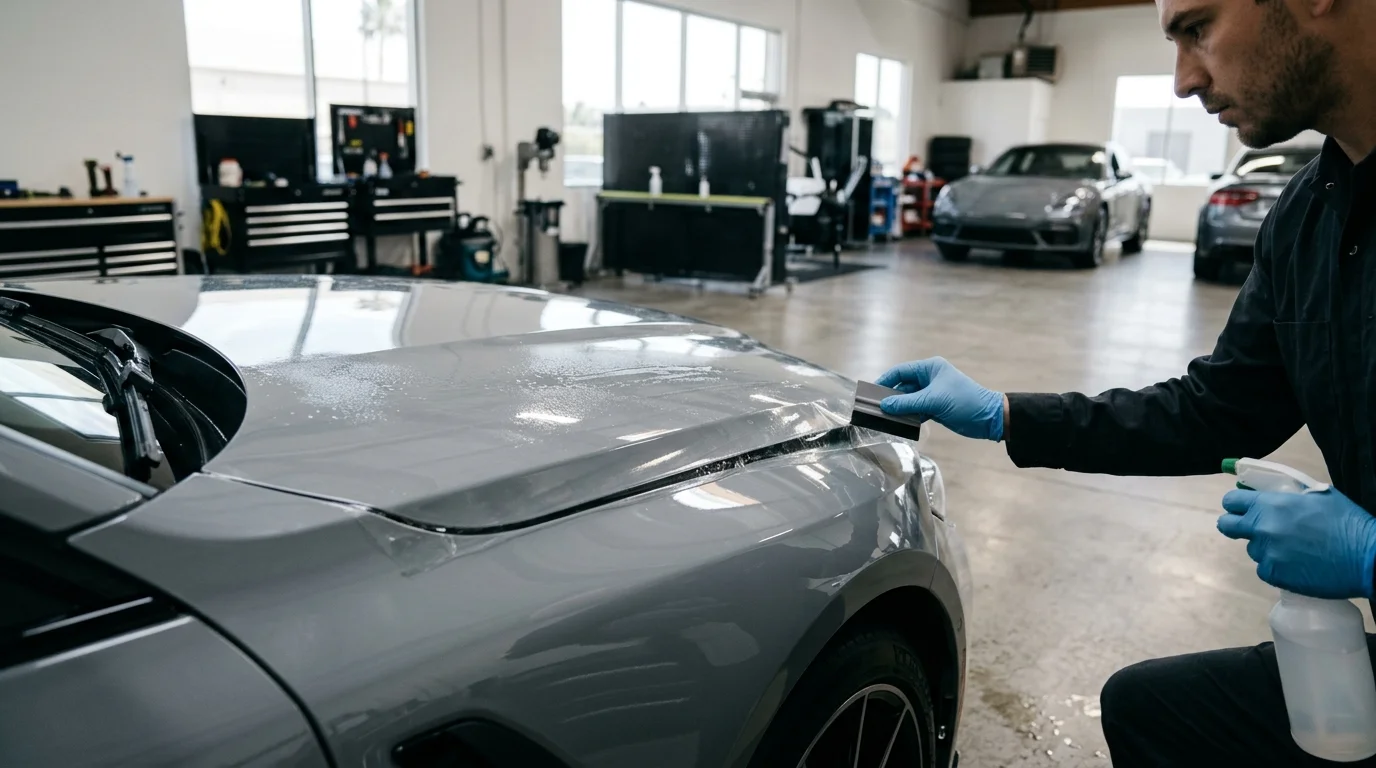
A paint protection film quote in this county pays for film, shop labor, and the work that happens before a panel is wrapped. The installer is buying professional-grade thermoplastic film, cutting it to your trim, and spending time on wash, decontamination, and edge work. Sensors, camera housings, and bumper seams add minutes on modern cars from Kearny Mesa lots as much as they do on a truck from Otay Mesa.
Typical market quotes published on this site run from $800 to $8,000. Your installer confirms the written price. A bumper-and-leading-edge job sits toward the low end. A full-body job on a large SUV or crew cab sits toward the high end. That spread is coverage and complexity.
You are also paying for what sits under the film. Clay bar is a decontamination step, not paint correction. It pulls bonded fallout after a wash so grit is not trapped under clear film. Machine polishing, when the paint needs it, is a separate line. Paint correction typically runs $300 to $1,200 depending on vehicle size and defect severity, and the installer quotes the safe stage before film goes on.
Time is part of the number. Full-body film on a standard vehicle typically takes 3 to 5 days. That is an expectation. The installer confirms the calendar. Same-week scheduling is available for most services. The car owner contracts and pays the installer directly.
If you want a line-by-line walk through of pattern cutting, wrapped edges, and prep, read what PPF prices include. This page stays on the San Diego cost drivers that make two ppf price near me quotes look nothing alike.
Getting matched costs you nothing. The in-person vehicle assessment and written quote cost the owner nothing. You pay the installer you choose for the work.
How coverage, body type, and paint prep change the number
Coverage is the first lever. A full-front PPF package usually means the bumper, hood, fenders, and often mirrors and headlights. A partial front may stop at the bumper and a strip of hood. Full-body film covers the painted exterior. The right map depends on how you drive.
Compare those maps in full front vs full body PPF in San Diego before you treat the cheapest line as the same job. Two quotes only match when the same panels, the same edge wrap, and the same prep sit on the page.
Body type is the second lever. A compact coupe has less film and simpler curves than a crew-cab truck or a three-row SUV. Deep bumpers, wide fender flares, running boards, and busy sensor cutouts add labor. A crossover that commutes Mira Mesa to Sorrento Valley often needs more linear feet of film than a two-door that lives in North Park. The installer measures the car in front of them.
Paint prep is the third lever. Clear film shows whatever is under it. Swirls, water spots, light scratches, and oxidation in the clear coat can be improved with machine polishing. Cracked paint, a prior respray, or failing clear coat changes the risk. Professional removal on healthy factory paint is the normal case. Failing or previously resprayed paint is the risk case, which is why the installer inspects first.
Existing wax or coating can interfere with film adhesion. The film installer specifies prep. Do not clay a coated car without that advice. Ask that prep appear as its own line so ppf pricing near me stays comparable from shop to shop.
Headlights, if they are in the quote, belong on their own line. Headlight protection film typically runs $150 to $250 for both front headlights, with added taillight coverage typically $250 to $400. Your installer confirms the written price.
Why I-15, I-5, and coastal parking show up in the scope
San Diego County has several driving surfaces, and the quote should reflect the ones you use.
I-15 through Escondido, Rancho Bernardo, and Miramar throws rock chips and truck debris at the front end. I-5 from Oceanside through Encinitas, Del Mar, and downtown adds coastal grit on top of the same pavement spray. I-805 through Mission Valley and the South Bay adds merge debris and construction sand. SR-78, SR-52, and SR-163 are shorter hits with the same physics. The threat on those routes is pavement.
That is why a Poway or inland North County commuter often starts with bumper, hood, and fenders. A weekend car that stays around University Heights or South Park may need a smaller map. Ask the installer to mark chip-prone panels on a sketch tied to your route.
Coastal parking changes scope in a different way. La Jolla, Pacific Beach, Mission Beach, Coronado, and Imperial Beach add salt air, sand, and bird droppings. Film is a physical shield from chips, scratches, and road debris. It can self-heal minor surface marks with heat. It still needs washing. Bug splatter, droppings, and sap can stain if they sit in sun.
A ceramic coating in San Diego is a liquid polymer that bonds to paint and creates a hard, hydrophobic surface layer. It resists water, UV, and light chemical exposure. It does not absorb rock chip impacts. Many owners film the front and coat uncovered panels. That is two products, two prices, and two care sheets.
Inland East County is the heat and dust version of the same problem. El Cajon, Santee, Lakeside, and Ramona bake horizontal panels. Film still wants a gentle wash. Avoid brush tunnels. Follow the installed product care sheet for soap, chemicals, and timing.
A clear bra car cost near me search from Chula Vista is a different scope than one from Encinitas when the first car lives on Otay Mesa truck routes and the second lives in a beach-adjacent garage. Tell the installer the route. The coverage sketch should change.
What to compare besides the bottom line
Compare coverage and prep before you compare the bottom line.
Start with the coverage sketch. Every panel listed, every panel left bare. Then the edge method. Wrapped edges tuck behind a panel. Trimmed edges sit in the open and collect grit. You need to know which one you were quoted.
Then prep. Wash, clay, polish, and panel wipe should be named. If polish is optional, the quote should say so. If old film has to come off first, that is extra labor. This site does not publish a removal price. Ask for it in writing.
Then the product tier. This referral brand is brand-agnostic. Searchers often type a manufacturer name plus cost. A named film line still needs a local written quote. Ask for the product the installer will use, in writing, and for the film warranty in writing. Your installer confirms the film warranty in writing.
Factory warranty questions come up on new cars. Under the federal Magnuson-Moss Warranty Act, enforced by the FTC, a vehicle manufacturer generally cannot void a warranty merely because an aftermarket product was used, absent a showing that the product caused the failure. State it that way. Causation is fact-specific.
Ceramic coating versus film is a product question. Coating typically runs $500 to $3,000. Film typically runs $800 to $8,000. Coating does not replace film on a chip-prone bumper. Film does not replace coating if you want easier washing on uncovered paint. For the keep-or-skip question, read is PPF worth it in San Diego.
Vinyl wrap is a different job. A full color-change wrap typically runs $2,500 to $6,500 depending on vehicle size and film. Partial wraps and chrome delete typically run $250 to $1,500 by scope. Wrap changes appearance and can protect the paint beneath it. Film is there to take chips. Treat wrap and film as separate quotes. Your installer confirms the written price on each.
Some films use urethane with a self-healing top coat for light surface scratches. That does not heal punctures, deep damage, or underlying paint. Light swirl and wash marks can reflow with heat. Deeper cuts stay.
A full respray is a different trade. A countywide paint-job figure could not be confirmed here. If the bumper already needs color work, ask the film installer and a body shop to sequence the jobs so film goes over finished paint.
When to ask for a rewritten, itemized quote
Ask for a rewritten, itemized quote when two numbers cannot be lined up side by side.
If one shop lists “full front” and the other lists bumper, partial hood, and fenders, those are different maps. If one includes paint correction and the other assumes a brand-new delivery from a Carlsbad or Kearny Mesa lot, the prep is different. If one names a product tier and the other says “professional-grade film” with no line item, you cannot compare care or warranty later.
Ask the installer to split film, labor, prep, extra panels, and light coverage. Ask how many days the car is typically on site. Full-body work is typically 3 to 5 days for a standard vehicle. Front-end work is often shorter. Those are hedged ranges. The installer confirms them.
Ask who is doing the work. Paint Shield SD refers. Independent, vetted, insured local installers install. The car owner contracts with the pro. If a quote is a verbal range in a parking lot, ask for the written version before you hold a date.
Ask what happens if they find failing clear coat or a prior respray. The honest next step is an inspection, then a revised scope. A number given without seeing the paint is a planning range.
If the rewritten quote is still a lump sum, coverage, prep, and product still need separate lines. That is how a ppf pricing near me search becomes a number you can stand behind in San Diego County.
When to call us
When the paint is still clean, or when the first chips are already arguing for bumper work, a professional film assessment is the next step. Call us at (760) 400-6557 and we’ll connect you with a vetted, insured local pro. Bring the year, make, model, and the freeways you actually drive.