The last minutes in the bay are when you learn how to inspect ceramic coating, not a month later in a Mission Valley garage. The independent pro is still there, and the lights are still on. Walk the written scope, a few panels, the edges, and the care sheet before you take the keys.
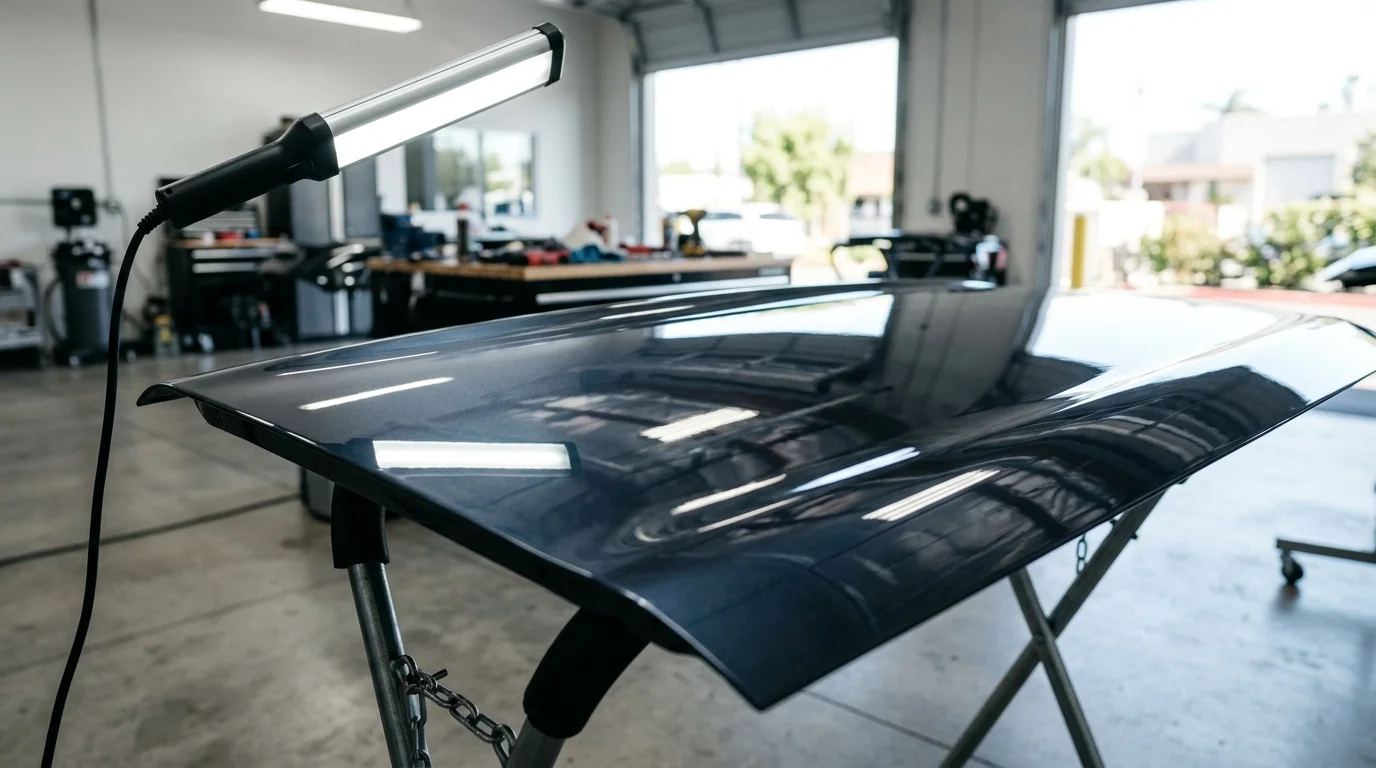
What you should see on the written scope before inspection
A ceramic coating inspection starts on paper. Ceramic coating is a liquid polymer that bonds chemically to paint. It creates a hard, hydrophobic surface layer. It resists water, UV, and light chemical exposure. It does not absorb rock chip impacts. That distinction belongs on the quote, so you are not inspecting film with a coating checklist.
Ask for the scope in writing before you look at paint. The sheet should name every panel that was coated. Hood, roof, fenders, doors, bumpers, mirror caps, and rockers are common. Door jambs, the engine bay, and wheels are not automatic. If wheels were part of the job, they should be listed.
The scope should also record whether paint correction happened first. Machine polishing can improve swirl marks, water spots, light scratches, and oxidation in the clear coat. The installer assesses paint and quotes the safe stage before any coating. If the quote skipped correction, you should already know that. Leftover swirls at pickup are then a known limit, not a surprise.
Product language stays generic here. We do not name coating brands. The independent pro should still write the product tier they used, the areas covered, and the written warranty the coating maker and the installer actually offer. Confirm those terms with them. A durability claim in years is not something we can verify, so do not treat a sales number as a standard.
Price belongs on the same paper. Professional ceramic coating in San Diego is typically quoted from $500 to $3,000, depending on vehicle size, paint condition, and whether correction is included. Your installer confirms the written price. Getting matched costs you nothing. You pay the independent pro you choose.
A typical coating job is often 1 to 2 days, with extra days when paint correction is included. Those are expectations, not a clock. Same-week scheduling is available for most services. Pickup timing is still the installer’s to confirm.
If the paperwork is thin, stop and ask. Choosing the shop is a separate conversation from inspecting the finish. Our guide on how to choose a coating installer in San Diego covers that step.
If you also had paint protection film installed, use a film checklist too. Coating and film fail in different ways. Walk how to inspect a PPF installation after the coating walkaround.
A coating is an aftermarket product. Under the federal Magnuson-Moss Warranty Act, a vehicle manufacturer generally cannot void a warranty merely because an aftermarket product was used, unless that product caused the failure. That is not a promise that your warranty is protected. Keep the installer’s and maker’s paperwork anyway.
How light and a few panels reveal prep problems
Shop light lies if you only stand at the front bumper. Walk the car the way San Diego light will hit it. Coastal cars in Encinitas, Pacific Beach, and Coronado pick up salt film and a low morning marine layer. Inland cars in El Cajon, Santee, and along I-8 sit in harder sun. The same panel can look even under a cool LED and patchy in noon glare.
Start with the hood, roof, and trunk. Those surfaces are large, flat, and honest. Then check the front bumper, the leading edges of the fenders, and the A-pillars. Those catch grit on I-5 and I-15. Then the lower doors and rockers, where beach-lot and parking-garage dust sits.
You are looking for prep problems coating will not hide. Coating follows the paint. If correction was quoted and the clear coat still shows heavy swirls, leftover water-spot etching, or dull oxidation in the same light, ask the independent pro to explain what you are seeing. Some marks live in the paint and were never going to fully leave. That should have been said before coating, not after.
Move your head as you walk. Reflections should travel across a panel without a sudden dull patch that does not match the rest of that panel. A dull patch can be missed product, leftover residue, or paint that was never leveled. There is no hardness number or pass-fail gloss spec we can cite. Ask the pro to look at the same angle you are using.
Check around badges, fuel doors, mirror gaskets, and shut lines. Prep shortcuts show up there first. A clean center of a door with a dusty, streaked pocket behind the handle is a prep story.
Do not put a machine on the car. Do not clay it. Clay is a decontamination step used before coating, not a pickup trick. Do not clay a coated car without the installer’s advice.
What high spots, missed edges, and residue can look like
Ceramic coating high spots are leftover product that flashed as a raised smear. They can look like a cloudy fingerprint, an oily streak, or a faint rainbow on a dark panel. On white paint they often show as a patch that stays wet-looking after the rest of the panel has evened out. Use your eyes, not your fingernail. You are documenting, not scraping.
Missed edges are the opposite problem. The center of a panel looks treated. The lip of a hood, the inside of a mirror cap, or the return on a bumper still looks dry, or it still matches neighboring uncoated plastic. Compare a coated fender to an uncoated door jamb if jambs were out of scope. The change should match the written map. It should not stop short of a body line the quote included.
Residue likes trim. Look at black plastic cladding, rubber window seals, and the edges of headlights. Hazed plastic and smeared rubber are common leftover signs. They are not proof the coating is coming off. A bonded coating is not a sticker. If you see a film edge lifting, you may be looking at paint protection film, not coating. Flag it and ask.
There is no defect standard in our claims ledger for how large a high spot may be, how far an edge may miss, or how much haze is acceptable. That standard, if it exists, lives with the independent pro and the coating maker. Ask them to confirm it on the car, in that light, before you leave.
Do not reach for a polish, a solvent, or a home mix. A DIY cut on a fresh coating can turn a small smear into a bald patch. Point at the mark. Take a phone photo in the same light. Ask the independent pro to recheck that panel while the car is still in the bay.
What aftercare instructions should be in writing
You should leave with a care sheet for the product that is actually on the car. It should cover soap, chemicals, timing, and whether a touchless wash or a pH-neutral hand wash is listed. Compatible maintenance toppers only. Do not assume carnauba wax is suitable on a coating.
Generic care guidance often includes a pre-rinse, a gentle hand wash with clean microfiber and a compatible neutral soap, a rinse, and a dry. Avoid brush tunnels. Do not let mineral-bearing water air-dry on the paint. San Diego irrigation overspray and coastal mist leave spots that look like coating failure and are often minerals sitting on top. Product instructions still control the chemicals and the timing. We cannot publish a universal first-wash wait, booster interval, or lifespan.
That sheet is also the honest answer to what destroys a coating. Brush car washes, chemicals the maker did not list, and contaminants left to sit (bird droppings, sap, wildfire ash) are the usual problems. The coating resists light chemical exposure. It is not a rock-chip film, and it is not permanent. Follow the sheet instead of a social-media mix.
If the independent pro offers a ceramic maintenance program, get that in writing too. Maintenance visits in this market are typically $150 to $350 depending on scope. Your installer confirms the written price. A maintenance visit is not a strip-and-recoat you do at home.
Ask how they want you to handle the first week of driving. Beach parking in Oceanside, a dusty inland commute through Escondido, and overnight street parking in North Park each load the paint differently. The care sheet should still win over folklore.
If a hose test is not on the care sheet yet, skip it. Water beading is not a pass-fail inspection we can certify. A premature wet-down can fight the maker’s timing. Waxes and spray toppers can also mimic beading, which is why a water show is a weak way to prove the job at the door.
When to ask the independent pro to recheck a panel
Ask for a recheck while you still share the same light. A photo from your driveway at dusk will not match what you both saw under the shop lamps.
Call them back to a panel when you see a high spot, a missed edge that was in scope, residue on trim, or a dull patch that does not match the rest of that panel. Call them back when the written map and the car disagree. A roof that was quoted and still looks untreated is a scope problem, not a later wash problem.
How to tell if ceramic coating is done is mostly this: the listed panels were coated, the prep matches what was quoted, the obvious application marks were addressed, and the care sheet is in your hand. How to tell if a coating is bad at handover is the same list. Months later, dulling or weaker water behavior can mean contamination on top of a coating, not a dead coating. That is a maintenance question, not a reason to polish at home.
How to tell if ceramic coating is coming off at pickup: you should not see a peeling skin. If something is lifting in a sheet, ask whether film, a topper, or residue is what you are looking at. Long-term wear is not a peel test we can specify. Confirm any warranty condition with the independent pro and the coating maker. Do not treat a forum lifespan as a rule.
Give the pro a chance to look. Point to the panel. Stay with them. If they need to keep the car to correct an application mark, that is their call and their process. You do not need to invent a chemical or a pad.
When to call us
When the job is still in the quote stage, or when a walkaround found something the independent pro should still address, talk with a professional Ceramic Coating and Paint Protection Film pro. Paint Shield SD matches car owners with vetted, insured local installers and does not apply the coating. Call us at (760) 400-6557 and we’ll connect you with a vetted, insured local pro.