A search for car clear bra installation near you should produce a written job, not a shop nickname. Compare which panels get film, how the paint is prepped, whether the work happens indoors, and how the pattern is cut. Those details change the install more than a package title on a map listing.
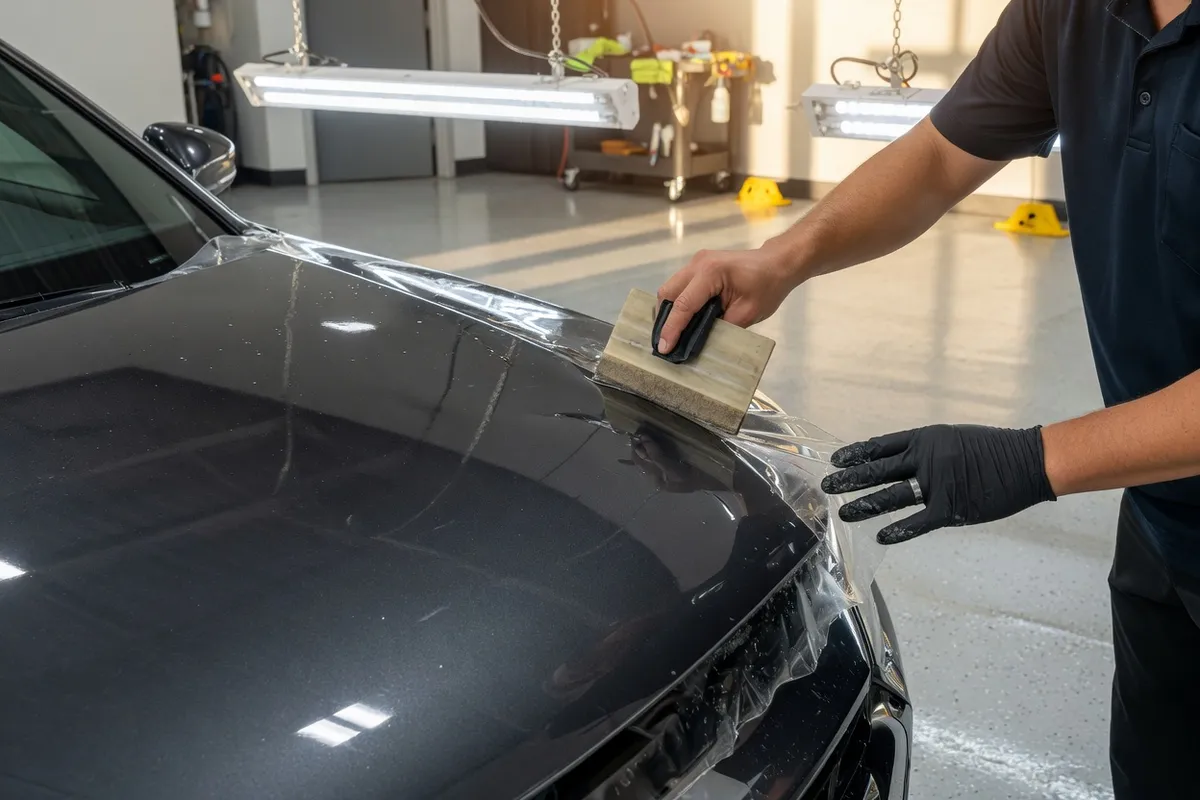
What a written install scope should identify
“Clear bra” is a nickname, not a specification. Two San Diego quotes can use the same phrase and still describe different cars.
Ask for a panel-by-panel list before you book. A useful scope names the hood, front bumper, front fenders, mirrors, and headlights, then says whether each piece is full or partial. A bumper-only job is not a full front. A partial hood that stops halfway up the panel is not the same as a hood covered to its edges. A full-front PPF package should still list every included piece. Full-body coverage is a different job: doors, rockers, rear quarters, and the rest of the painted shell.
The scope should also say how each edge will finish. A wrapped edge continues around an accessible panel lip so the termination sits off the face you see while driving. A cut-short edge stops on the visible paint. Neither finish is automatically better. Bumper returns, tight fender lips, headlight housings, and sensor openings often force a planned cut. You want that called out before the appointment, not discovered at pickup.
Other booking facts belong in the same document. Name the film product line instead of a vague premium label. State whether the car stays in a shop bay or a driveway. State whether the pattern is computer-cut or trimmed on the vehicle. Name who performs the install. Explain what happens if the in-person paint inspection changes the plan.
Paint Shield SD matches you with a vetted, insured local pro. The independent installer writes the scope, does the work, and confirms the price. Review the broader paint protection film options first so you are comparing the same service category.
How coverage, film choice, and paint prep change the job
Coverage is the first reason two installs are not comparable. Daily debris on I-15 through Miramar, I-5 through Kearny Mesa, and SR-52 between those corridors hits the nose first. Truck grit, construction chips, and canyon wind on SR-52 land on the bumper, the leading hood, the fender faces, the mirror caps, and the headlight lenses. A bumper-only job leaves the hood exposed. A partial hood leaves a visible stopping line across the paint. Full-front coverage moves those boundaries to panel edges. Full body is for a different goal and a different budget.
Typical PPF work in this market runs $800 to $8,000 depending on the vehicle and how much of it is covered. Full-front jobs are often discussed in the $1,500 to $3,000 band. Your installer confirms the written price after seeing the car.
Film choice is the second variable. Readers often ask about 3M as a film family. Treat that as a starting label. The quote still needs the exact product line and finish. Paint Shield SD does not sell a film brand, and a brand nickname is not a certified-installer claim.
Paint prep is the third. Film follows the surface under it. Wash marks, haze, and chips do not disappear because they are covered. If the installer recommends correction, ask which panels and why. Paint correction typically runs $300 to $1,200 when it is needed. That work should be a separate, agreed step, not a surprise on install day.
For the money comparison itself, use what PPF prices include. This page is about whether two shops are proposing the same install. If you also want coating on unfilmed panels, review ceramic coating in San Diego as a separate service, not a substitute for film.
Why shop conditions and pattern cutting matter
An enclosed bay gives the installer lighting, still air, and room to handle large sheets. A driveway adds wind, grit, passing traffic, and, near the coast, a damp marine layer on the paint. A closed residential garage sits between those two. The setting is part of the job you are booking, not a convenience extra.
Ask where the car will sit for the entire install, including wash, prep, and film lay-down. Leaf blowers, landscaping dust, and cars rolling through a shared lot are ordinary San Diego problems. They are harder to control when a full hood or bumper sheet is in the air. If the pro prefers indoor work for a full front, that is a quality signal, not a delay tactic. Same-week scheduling available for most services. The installer still has to confirm that the workspace matches the coverage.
Pattern cutting changes the job as well. A computer-cut pattern is plotted for the year, make, and model, then cut before it touches the car. The installer aligns pre-cut pieces to panel lines, openings, and sensor cutouts. A hand-cut install lays film on the panel and trims it in place. That can be skilled work. It also puts a blade near painted edges, headlights, and bumper gaps, and it can produce more variation from car to car.
Neither method is a slogan you should trust by itself. Ask which method is planned for your vehicle, especially around headlights, camera openings, and wrapped bumper ends. Then ask how the installer will show you those cut lines at pickup.
What to inspect before you drive away
Do not accept the keys against memory. Bring the written panel list and walk the car in daylight before you leave. Confirm every listed piece is filmed, including mirrors and headlights if they were in the scope. Look at edges from more than one angle. Ask the installer to point out wrapped edges versus planned cut-short lines so you are not treating an intentional boundary as a miss.
This pickup check is a booking close-out, not a full defect tutorial. For the detailed walk-around, including lighting, debris, emblems, and early moisture, use how to inspect a PPF installation. Photograph anything you want the installer to review while the car is still there. Do not press, heat, or peel an edge yourself.
Ask for the film and workmanship paperwork before you drive away. Paint Shield SD does not warrant the install. Your installer confirms those terms in writing.
Questions to ask an independent installer
Send the same short list to every shop. You are checking whether they will do the same job, not collecting slogans.
- Which exact panels are included, and is each full or partial?
- Will the install be indoors, in a closed garage, or in a driveway?
- Is the pattern computer-cut or trimmed on the car?
- Which edges will wrap, and which will cut short on this vehicle?
- Who will install the film, not only who wrote the quote?
- Is paint correction included, optional, or declined after inspection?
- Can I inspect the car with you before I drive away?
- What changes the written price after you see the paint?
If you want a broader shop-comparison checklist, read how to choose a coating installer in San Diego. The same process questions apply to film: inspection, prep, workspace, and a written close-out.
Getting matched costs you nothing. You contract with and pay the independent pro directly.
When to call us
Call when you want a local installer to turn a clear bra search into a written panel list, prep plan, and indoor or driveway booking. Share the vehicle, your usual freeways, and which front pieces you want covered.
Call us at (760) 400-6557 and we’ll connect you with a vetted, insured local pro.