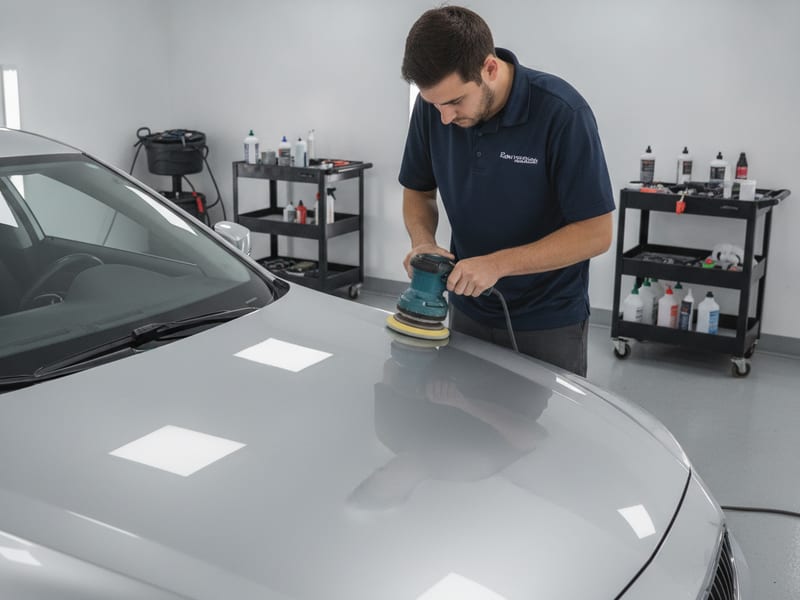
A clay bar isn’t paint correction. It doesn’t level swirl marks. It is a decontamination step that pulls bonded grit off the clear coat after a wash, before any coating is asked to stick.
If bonded contamination remains after washing, it can interfere with coating preparation. A wash alone does not always move every particle, which is why the installer inspects the paint before choosing a decontamination method.
Paint Shield SD matches San Diego County car owners with vetted, insured local installers. The pro who quotes your coating should say whether clay is in the prep, not treat it as a mystery add-on.
What clay actually does
After a thorough wash, the paint can still feel rough even when it looks clean. That grit is mechanically attached. Clay, used with a lubricant, shears those particles off the surface.
Clay and chemical decontamination are different tools. Clay is a mechanical step; a chemical product may be selected for a specific contaminant. The installer should choose and sequence them for the paint in front of them and the coating manufacturer’s preparation requirements.
If polishing is needed, the surface should first be clean and free of contamination that would interfere with that work. Clay may be part of that preparation when inspection shows it is needed.
The paint correction before ceramic coating guide covers the polishing decision. This page covers the separate contamination check that informs preparation.
When inspection shows a car needs it
Cars can collect salt film, airborne grit, road debris, and other bonded contamination. None of those exposures creates a useful universal “times per year” clay schedule.
The installer judges it on the car in front of them. A daily driver that already feels smooth after a wash may need less mechanical decontamination. A vehicle with a rough surface or visible bonded contamination may need more.
Don’t invent a schedule and clay a coated finish every season. Before using clay, tar remover, or another decontamination product on a coated surface, check the coating manufacturer’s directions or ask the installer. Our coated-car maintenance guide covers that decision.
What clay does not do
Clay won’t hide swirls. It can leave light marring if it is used dry, dropped on the floor, or loaded with grit. That is one reason this step belongs in a controlled prep, not as a driveway experiment the night before a coating.
It won’t fill chips. It won’t repair oxidation that needs a polish. It won’t make PPF unnecessary on the front of a highway car.
If the quote for ceramic coating lists inspection and the preparation selected for your paint, you can see what is included. If it only lists “coating,” ask how the installer checks for bonded contamination and decides whether chemical or mechanical decontamination is needed.
How to ask for it on the estimate
Three questions are enough:
- Is clay in the written prep, or is it extra?
- What contamination did the inspection find, and why is the proposed method appropriate?
- What happens if the paint still feels rough after the first decontamination step?
Same-week scheduling is available for most services. The installer confirms the written price after they see the car. Ceramic coating in San Diego County typically runs $500-$3,000 depending on vehicle size, paint condition, and coating tier.
To get matched, call (760) 400-6557. Getting matched costs you nothing.