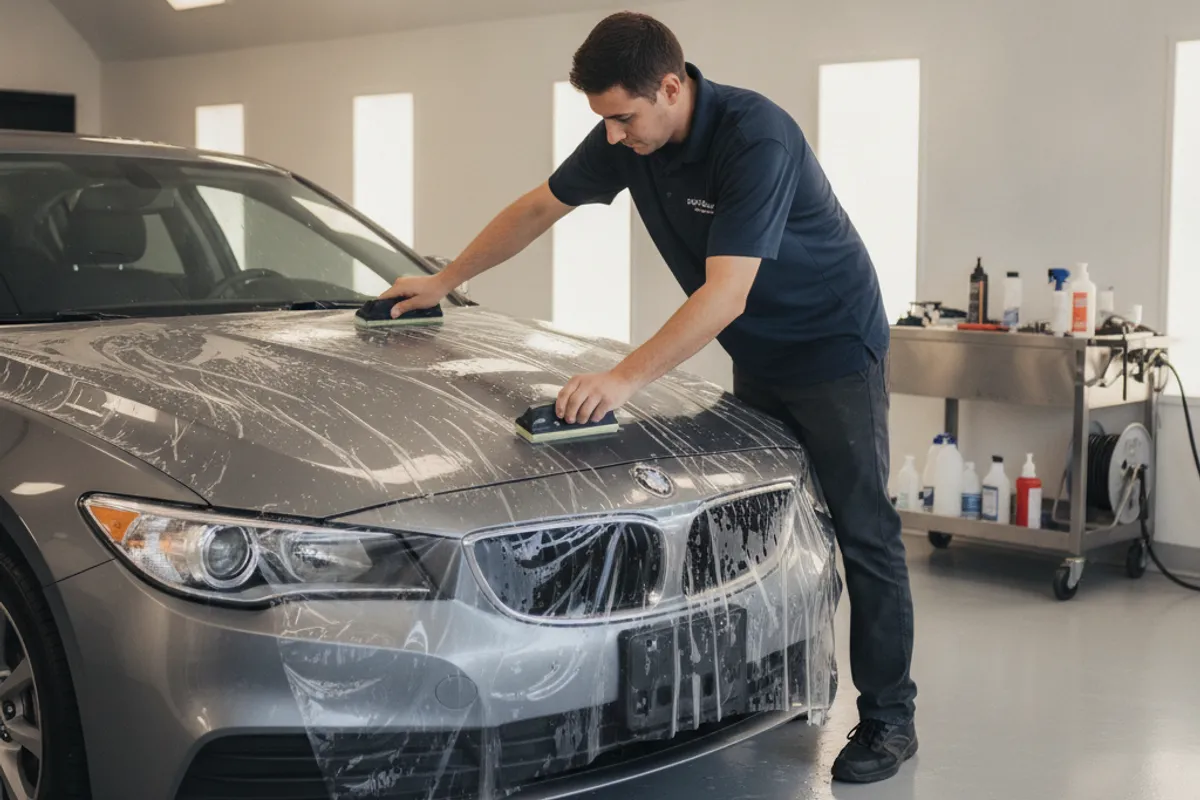
What “clear bra” actually means
Clear bra is a common name for paint protection film (PPF) applied to the front of a vehicle. The name comes from the original black vinyl bras that covered car hoods and fenders before transparent urethane film technology existed. Current PPF products use a clear urethane film as a sacrificial layer against road debris. Appearance, performance, and warranty terms depend on the specific product and installation.
The typical clear bra package covers the front bumper, full hood, front fenders, side mirrors, and A-pillars. Some installers also include headlights in the base package; others price headlights as an add-on.
Why daily drivers in San Diego are good candidates
The case for PPF on a daily driver comes down to where the damage happens. San Diego’s freeway corridors are hard on front-end paint. The 15 through Miramar and Scripps Ranch, the 5 through Kearny Mesa and Linda Vista, the 78 in Vista and San Marcos, and the 8 through Santee all carry heavy truck traffic that generates road debris. A car commuting 25,000 miles per year on these freeways accumulates rock chips faster than most owners realize until they look closely at the hood under a sunny sky.
A chip-covered hood may need touch-up, correction, or refinishing, and those are quoted after inspection. A full front clear bra installation costs $1,500-$3,000 for a standard vehicle. Compare that upfront cost with the condition you want to preserve and the amount of road-debris exposure the car receives.
The practical questions for a daily driver
How long will the film last on a car driven every day?
There is no universal lifespan for PPF on a daily driver. The installed product, film condition, exposure, storage, and washing all matter. Ask the installer for the written warranty and care instructions for the exact product rather than relying on a general figure.
Does the film look different from the surrounding paint?
A well-installed clear film can be difficult to notice under normal viewing conditions, although seams and edges may still be visible. Ask which edges will be wrapped, which will remain exposed, and where film will meet unprotected paint. Inspect a finished vehicle in daylight if appearance is a deciding factor.
Does daily driving put more stress on the film?
Mileage is a proxy for exposure, not a complete predictor of film condition. A high-mileage car with careful washing could age differently from a low-mileage car with harsher washing or more outdoor exposure. Ask the installer which conditions affect the quoted film and how to inspect it over time.
What daily driver budgets usually look like
San Diego daily driver PPF packages generally fall into three tiers:
Partial front coverage: Bumper plus the leading section of the hood and fenders. The cheapest way to protect the zone that takes the most chips, and the trade-off is a visible film edge partway across the hood.
Full front, at the lower end of $1,500-$3,000: The full bumper, hood, fenders, mirrors and A-pillars edge to edge, with the film edge wrapped at the natural panel edge instead of mid-hood. This avoids the partial package’s mid-hood seam when the quote includes wrapped edges.
Full front at the upper end, plus door cups and rockers: Adds door edge and rocker coverage. Relevant for vehicles that park in tight urban situations around Hillcrest, North Park, downtown, or Little Italy where door dings and rocker scrapes are real risks. Your installer confirms the written price after seeing the vehicle.
Ceramic coating over compatible film and on unprotected panels is an optional, separately quoted service. Ask whether the coating is approved for the specific film and what maintenance changes before deciding whether the combination is useful for you.
What to tell the installer about your driving habits
A good installer will ask about your commute, parking situation, and how you wash the car. Tell them specifically which freeways you use regularly, whether you park in structures or lots, and whether you garage the car at home. This information affects which coverage areas make the most sense for your situation.
Frequently asked questions
What is a clear bra?
Clear bra is the older name for paint protection film, an optically clear urethane film installed over painted panels to absorb rock chips and road debris. Installers use both terms for the same product, and there is no difference between them.
Is a clear bra worth it on a daily driver in San Diego?
It can be practical for a freeway commuter who wants to preserve front-end paint. The case is weaker when the car sees little road-debris exposure or the owner does not value avoiding chips enough to justify the cost.
How much does a clear bra cost in San Diego?
Full front runs $1,500-$3,000 depending on vehicle size and film tier. Partial front coverage costs less and protects the highest-impact area, with the trade-off of a visible film edge partway across the hood.
Does a clear bra damage the paint underneath?
Installation and removal on healthy factory paint are different from work over failing or previously resprayed paint. Ask the installer to inspect the finish, explain the removal risk for that paint, and document any concern before installation.
Clear bra or ceramic coating for a daily driver?
They do different jobs. Film is a thicker sacrificial layer for physical impacts; coating is chosen for surface behavior and easier cleaning. A common daily-driver setup is film on the front end with a compatible coating on selected surfaces, which is covered in ceramic coating vs paint protection film.
How do I wash a car with a clear bra?
Follow the film manufacturer’s written wash instructions and the installer’s edge-care guidance. Ask which soaps, wash methods, and pressure-washing practices are compatible with the installed product.
For a full overview of what PPF options exist beyond front-end coverage, see the paint protection film service page. For information on adding ceramic coating to a daily driver, see the ceramic coating service page. To get matched with a vetted San Diego installer, call (760) 400-6557.